



What to do if your flooring is prone to sanding? A comparison of 5 types of flooring materials + construction remedial methods explained at a glance.
Quick overview of key points: Solutions for floor sanding
1. Common flooring problems such as sanding, powdering, cracking, difficulty in cleaning, and insufficient wear resistance are mostly related to improper material selection and construction procedures.
2. Comprehensive Analysis of 5 Major Differences in Flooring Materials: Epoxy, PU, Concrete Hardener, Self-Leveling Compound, and Inorganic Ceramic Stone Flooring
3. How to Correctly Choose Flooring Materials by Considering Abrasion Resistance, Weather Resistance, Cleaning Needs, and Application Areas
4. Compilation of 7 Common FAQs, Answering Practical Questions such as How Long Can Flooring Last? Is it Suitable for Outdoor Use? Is it Suitable for DIY?
5. In-depth Introduction to the Application Trends of Next-Generation Inorganic Flooring Materials, Analyzing Why Weather Resistance, Abrasion Resistance, and Low Maintenance Have Become the Market Mainstream

1. Common flooring problems such as sanding, powdering, cracking, difficulty in cleaning, and insufficient wear resistance are mostly related to improper material selection and construction procedures.
3. How to Correctly Choose Flooring Materials by Considering Abrasion Resistance, Weather Resistance, Cleaning Needs, and Application Areas
4. Compilation of 7 Common FAQs, Answering Practical Questions such as How Long Can Flooring Last? Is it Suitable for Outdoor Use? Is it Suitable for DIY?
5. In-depth Introduction to the Application Trends of Next-Generation Inorganic Flooring Materials, Analyzing Why Weather Resistance, Abrasion Resistance, and Low Maintenance Have Become the Market Mainstream
What to do if your flooring is prone to sanding? A comparison of 5 types of flooring materials + construction remedial methods explained at a glance.
The root cause of concrete floor dusting is mostly due to an incomplete sealing of the concrete surface, or incomplete grinding or primer application during construction.
Simply cleaning or surface repairs will usually result in recurring dusting problems.
In practice, improvements must be made to both material selection and construction procedures to truly resolve concrete floor dusting.

【Why is it essential to use coatings for flooring? They provide the core foundation for durability, safety, cleanliness, and a positive user experience.】
Flooring will naturally wear down, but most users don't realize that the "speed and extent of damage" depends on the adequacy of the surface protective layer. Without a protective coating, the concrete surface is more prone to absorbing water and oil, powdering, peeling, and even affecting structural safety. This chapter will break down, from a practical perspective, why flooring coatings are essential and the real benefits they bring.
1. Common Problems and Risks of Using Flooring
Floors without coatings or using incorrect materials will face the following problems:
(1) Floor powdering and sanding, leading to a surge in environmental dust
Concrete will "powder" under long-term foot traffic, generating a large amount of dust, affecting air quality and increasing cleaning costs.
(2) Oil stains seep into the substrate, drastically increasing cleaning difficulty
Unprotected flooring will absorb oil like a sponge, making it almost impossible to remove once the oil stains penetrate.
(3) Heavy objects dragging causes cracks and pits
Without proper coating protection, the surface of the floor will gradually develop fine cracks, pits, and peeling.
(4) Moisture seepage leading to peeling or salt damage
In humid environments, if the floor's pores are not sealed, moisture seepage will cause salt to rise to the surface (efflorescence).
(5) Chemical corrosion of the floor
Factories and food processing spaces often encounter acidic and alkaline agents, which will quickly damage the floor without a protective coating.
2. Four Core Functions of Floor Coatings
(1) Enhanced Wear and Pressure Resistance
Prevents chalking and sanding, allowing the floor to withstand high flow and high load conditions.
(2) Stain and Permeability Prevention, Easy Cleaning
The coating blocks grease, chemicals, and pollutants, making the floor easier to maintain.
(3) Enhanced Safety and Structural Stability
Prevents the expansion of microcracks and water vapor erosion, improving the overall durability of the building.
(4) Increased Aesthetics and Texture
Coatings can create various effects such as glossy, matte, stone-like, and industrial gray finishes, enhancing the professionalism of the space.
3. Summary of the Importance of Floor Coatings
The purpose of floor coatings is not merely to "make the floor look pretty," but rather to:
Extend the lifespan of the floor
Reduced maintenance costs
Improve cleaning
Enhance safety
Enhance texture and user experience

【Which material should be used for floor coatings that cause sanding? A complete comparison of 5 types of floor coatings.】
There are many types of floor coatings on the market, from epoxy commonly used in industrial floors to PU used in sports fields, to hardeners commonly used in warehouses, and self-leveling compounds favored in commercial buildings. Each material has its own characteristics and limitations. This chapter will help you find the right floor material based on usage scenarios, wear resistance, weather resistance, and aesthetics, and will analyze why the newly emerging "inorganic ceramic stone flooring" has become a popular choice.
Introduction to Five Mainstream Flooring Materials
1. Epoxy flooring is suitable for which spaces? Why is it not suitable for outdoor?
Epoxy is a type of resin-based flooring with high strength and a shiny appearance, commonly used in:
warehouses
basements
company logistics spaces
sunless industrial areas
advantage
- High wear resistance,
- high pressure resistance; Smooth surface, beautiful appearance;
-
Rich colors, can be used for marking lines
Disadvantages
Not resistant to ultraviolet light, turns yellow and becomes brittle outdoors
High requirement for base dryness
Cracks may appear under heavy pressure or high temperature
2. Why is PU flooring commonly used in sports fields and food processing areas?
Applications
Sports fields
Food processing spaces
Places requiring shock absorption
Advantages
High elasticity, impact resistance
Low sensitivity to temperature changes
Higher acid and alkali resistance than Epoxy
Disadvantages
Higher cost
Color brightness is not as good as Epoxy
Slightly softer surface, less scratch-resistant than inorganic flooring
3. Can concrete hardeners really solve the problem of sanding?
Applications
Warehouses
Industrial floors
Garages
Advantages
Prevents sanding
Improves surface hardness
High cost-effectiveness
Disadvantages
Significantly changes appearance
Unsuitable for high-wear, high-demand areas
Not a true high-strength flooring coating
4. Who is self-leveling flooring suitable for? High flatness but is it durable?
Applications
High-end commercial spaces
Showrooms
Residential flooring leveling
Advantages
Unbeatable flatness
Can be paired with a transparent topcoat for a high-quality look
Disadvantages
Not resistant to heavy abrasion
Easily damaged without a protective layer
High requirements for the construction environment
5. What is ceramic crystal flooring? Why is it considered a new generation of flooring material?
Made using recycled raw materials, reducing energy consumption and carbon emissions, it offers a natural stone feel and beautiful texture, presenting the texture of natural stone. Therefore, it possesses:
High hardness (close to natural stone)
Non-yellowing (UV resistant)
Scratch-resistant, abrasion-resistant, and chemical-resistant
Suitable for both indoor and outdoor use
Low oil absorption, easy to clean
Enhances the texture and design of spaces, making it the fastest-growing new material in the market.
Advantages
Super abrasion-resistant and scratch-resistant
Non-yellowing outdoors
Excellent aesthetics, presenting a stone-like feel
Lifespan can reach over 10 years
Disadvantages
Requires installation according to systematic chemical methods
If the floor is damaged, it needs to be repaired first.
Table 1 Comparison of Flooring Materials
地坪材料(中文)
Material Type (EN)
耐磨性 Abrasion Resistance
美觀度 Aesthetic Quality
耐候性 Weather Resistance
適用場域 Suitable Areas
價格區間 Cost Level
Epoxy 環氧地坪
Epoxy Floor Coating
★★★★
高亮度 High Gloss
★★
室內 Indoor
中
PU 聚氨酯地坪
PU Floor Coating
★★★★
中等 Medium
★★★
室內、運動場 Indoor, Sports Areas
中高
混凝土硬化劑
Concrete Hardener
★★
低 Low
★★★
工廠、倉庫 Factories, Warehouses
低
水泥自流平
Self-Leveling Floor
★★
高 High
★★
商業空間 Commercial Spaces
中
陶晶石地坪
Crystal Stone Floor Coating
★★★★★
高質感 Premium Texture
★★★★★
室內外皆可 Indoor & Outdoor
中高

【How to choose core floor coatings? Quickly determine based on the application area and degree of wear.】
Many people only consider price when choosing flooring materials, but factors such as wear resistance, cleaning needs, frequency of chemical use, and weather resistance requirements in different locations directly influence material selection. This chapter will teach you to use a "three-core thinking framework" to quickly find the most suitable flooring material, avoiding wasting money, choosing the wrong material, and affecting the lifespan of the floor.
1. Which type of flooring should be chosen for high-wear spaces (vehicles, trolleys, heavy objects)?
High Abrasion (Vehicle traffic/Frequent cart movement/Heavy load dragging)
Recommendation: Ceramic stone, Epoxy + Abrasion-resistant mortar
Reason: Pressure and scratch resistant, long lifespan.
Medium Abrasion (Factory/Warehouse)
Recommendation: Epoxy, Ceramic stone
Reason: Combines abrasion resistance and stain resistance.
Low Abrasion (Residential/Commercial)
Recommendation: Self-leveling compound, PU, Ceramic stone
Reason: Emphasis on aesthetics.
2. What should be prioritized for residential and commercial flooring?
Indoor Environment
✔ Epoxy
✔ PU
✔ Self-leveling compound
✔ Ceramic stone
Outdoor Environment
Sole Recommendation: ✔ Ceramic stone flooring
Reason:
Non-yellowing
UV resistant
Non-brittle
Excellent weather resistance
3. Why shouldn't outdoor flooring only consider price?
Areas prone to oil stains (parking lots, machinery areas)
Recommendation: Ceramic stone, PU
Areas requiring frequent cleaning (restaurants, medical facilities, laboratories)
Recommendation: Epoxy, Ceramic stone
A need to maintain a smooth and aesthetically pleasing surface (commercial display spaces)
Recommendation: Self-leveling compound + transparent protective layer
or Ceramic stone (matte or glossy stone finish)
Material Selection Summary
Choosing the right flooring can be summarized in one sentence:
If you prioritize durability and aesthetics → Ceramic Crystal
If you need vibrant colors → Epoxy
If you need elasticity and impact resistance → PU
If you only want sand control → Hardener
If you want a smooth, high-quality finish → Self-leveling flooring
Table 2 Quick Material Selection Comparison Table
使用場域
Application Area
首選材料
Primary Recommendation
次選材料
Alternative Option
選材重點
Key Criteria
停車場
Parking Lots
陶晶石
Crystal Stone
Epoxy
Epoxy
耐磨、抗油
Abrasion & oil resistance
工廠走道
Factory Walkways
陶晶石
Crystal Stone
Epoxy
Epoxy
高流量耐用
High-traffic durability
倉儲空間
Warehouses
Epoxy
Epoxy
硬化劑
Concrete Hardener
成本與耐磨
Cost vs wear
商業展示
Commercial Showrooms
自流平、陶晶石
Self-Leveling, Crystal Stone
PU
PU
平整與質感
Flatness & aesthetics
住宅空間
Residential Floors
自流平、陶晶石
Self-Leveling, Crystal Stone
PU
PU
好清潔
Easy maintenance
戶外走道
Outdoor Walkways
陶晶石
Crystal Stone
—
—
耐候、不黃化
Weather resistance
This article is compiled from actual flooring project experience and comparisons with materials on the market, with long-term durability and low maintenance costs as the core evaluation criteria.

【How to ensure durable floor coatings? Five essential standard procedures are indispensable.】
The quality of flooring projects is not determined by the price of materials, but by whether the construction process is standardized. Many flooring problems, such as peeling, cracking, and chalking, are often not due to poor materials, but rather to deficiencies in the construction process. This chapter will break down the complete construction process of floor coatings, and take inorganic ceramic stone flooring, which boasts the highest durability, as an example to analyze each key step of standardized construction.
Whether you're working with Epoxy, PU, self-leveling, or ceramic stone, the five steps are almost identical, differing only in the degree of detail. Understanding these steps will allow you to discern the quality of construction and avoid future maintenance problems.
Standard Construction Method for Floor Coating: Five Steps
Step 1 | Substrate Grinding (Base Surface Remodeling): Why must the floor be ground first? What will happen if it is not ground?
Purpose and Importance
Substrate grinding is the most important and indispensable step in all flooring projects.
Because this step determines:
Adhesion;
whether it peels off after application;
whether the surface is smooth;
whether the lifespan can be extended to 5-10 years or more.
Main tasks of grinding
Remove old coatings, chalking layers, and oil stains.
Remove weakened layers and surface abrasive particles.
Grind to create a uniform, roughened texture, allowing the base coat to penetrate.
Smooth the surface, eliminating layers.
Consequences of not grinding
- Severe peeling;
- short-term cracking;
- surface blistering;
-
difficult to clean accumulated dust.
Step 2 | Crack Reinforcement × Pothole Repair
Objectives:
- To prevent crack propagation
- To eliminate weakened structures
- To fill potholes and maintain a smooth surface
Common reinforcement methods
- V-shaped cutting reinforcement method: Cut along the crack, inject adhesive, and then seal.
- Resin mortar repair method: Fill potholes and depressions.
- Local leveling of uneven surfaces.
Is crack reinforcement really important? What are the consequences of ignoring it?
Because "surface cracks are merely a consequence," the real problem lies in damage to the underlying structure.
If not reinforced:
cracks will extend again from beneath the paint;
the floor coating will be pulled apart and peel off;
creating safety risks.
Step 3 | Primer Application: What key role does the primer play in flooring projects?
The function of primer
- Penetrates concrete capillary pores
- Seales the floor's water absorption,
-
preventing a significant increase in the amount of main material needed
Strengthens adhesion, -
allowing the coating to bond seamlessly with the floor
Improves subsequent wear resistance and pressure resistance
The Importance of Primer Quality
The importance of primer is often overlooked, but its function is equivalent to:
"Adhesive for flooring × Sealer × Reinforcement layer"
In inorganic ceramic stone flooring, primer allows crystallized minerals to adhere firmly and also allows the main material to be distributed more evenly, resulting in a denser and harder final coating.
Step 4 | How does the coating of the main material affect abrasion resistance and service life?
Taking ceramic stone flooring as an example, this step is the core project of the entire system.
The role of ceramic crystal stone as the main material
- Forms a high-hardness crystalline coating;
- scratch-resistant, abrasion-resistant, and oil-resistant;
- excellent chemical resistance;
- can be finished with a glossy or matte finish upon request.
The importance of main materials
The coating method, thickness, uniformity, and number of coats of the main material will directly determine:
- Lifespan;
- Aesthetics;
- Scratch resistance;
-
Stain resistance
Differences between ceramic crystal stone and resin-based coatings
- Resin ages, while inorganic ceramic crystal stone does not.
- Resin has poor weather resistance, while mid-to-high-end ceramic crystal stone does not yellow.
-
Resin has limited scratch resistance, while ceramic crystal stone has a hardness approaching that of natural stone.
Step 5 | How much longer can a top coat extend the life of a floor?
Function
The topcoat protective layer is responsible for:
- Enhanced stain resistance
- Increased scratch resistance
- Improved UV resistance
- Enhanced gloss or matte finish
-
Extended overall lifespan
The topcoat is an extra protective layer that helps maintain the base material's optimal condition and ultimately achieve its desired texture.
Cure time after application:
Walking is possible after 24 hours.
Weight-bearing is possible after 48–72 hours.
Fill-ups, primers, base materials, and topcoats all require proper drying to prevent damage to the coating.

【What accounts for the price difference in floor coatings? Why is there such a large gap in the quoted prices?】
The differences in floor coating costs stem not only from the materials themselves, but also from factors such as floor condition, construction difficulty, area size, usage requirements, and durability needs. This chapter will break down why floor coating costs vary so much, what situations increase costs, and how to determine if a quote is reasonable, helping users better understand where to allocate their budget.
1. Common flooring pricing items and price ranges (NT$/ping)
Table 3. Flooring Quotation Items and Ranges
施工項目(中文)
Work Item (EN)
單價區間
素地研磨/基面重整
Surface Grinding & Substrate
Preparation
1,000 – 2,500
裂縫補強與修補
Crack Reinforcement & Repair
500 – 1,500
Epoxy 地坪
Epoxy Floor Coating
1,800 – 3,500
PU 地坪
PU Floor Coating
2,000 – 4,000
混凝土硬化劑
Concrete Hardener
500 – 1,000
自流平找平
Self-Leveling Layer
1,500 – 3,000
陶晶石地坪
Crystal Stone Floor Coating
3,000 – 4,500
Five Key Factors Affecting Price
1. Substrate Condition (Most Critical)
Severe chalking → Requires deep grinding
Many cracks → Increased reinforcement costs
Dampness → Requires moisture-proofing treatment
The worse the substrate, the higher the initial construction costs.
2. Material Type Differences
Resin Type (Epoxy, PU)
Medium unit price
Shorter lifespan (5-8 years)
Inorganic Ceramic Stone
Higher unit price
Longer lifespan (10+ years)
Less frequent rework, lower long-term cost
3. Usage Needs (Industrial vs. Commercial vs. Outdoor)
Industrial
Requires high strength, wear resistance, and chemical resistance → Higher cost
Commercial
Requires high aesthetics → Self-leveling or ceramic stone (matte, glossy)
Outdoor
Requires weather resistance → Inorganic ceramic stone is the only suitable option
4. Construction Area Size
Large areas: Lower unit price
Small, scattered areas: Higher labor and fixing costs
5. Requirement for Removing the Old Coating
If the old coating is peeling, bubbling, or powdering, it must be completely removed.

【7 Frequently Asked Questions about Floor Coatings (Answers to All Your Questions)】
In flooring planning, the most common questions users encounter are: Is it durable? Can it be DIY-ed? How long will it last? Can it be used outdoors? Can the flooring be used in high-wear areas? This chapter compiles the 7 most frequently asked questions in practice, allowing you to understand the core concepts of flooring coatings at once and avoid making the wrong choice or being misled by incorrect information.
FAQ 1 | How long does it take to apply floor coating? Will it affect its use?
Generally 1–3 days, depending on the area, surface condition, and material type.
FAQ 2 | Approximately how many years can different floor materials be used?
|
|
Service Life |
||
|
|
3–5 年years |
||
|
Epoxy |
5–8 年(戶外更短)years |
||
|
PU |
5–8 年years |
||
|
Crystal Stone |
10 年以上years |
FAQ 3 | What materials can be used for outdoor flooring?
✔ The only high-weather-resistant building material suitable for outdoor use: Inorganic ceramic stone flooring
✘ Epoxy and PU will yellow, become brittle, and are not weather-resistant under UV light.
FAQ 4 | Which parts of the flooring project can be DIY?
Only the following items can be DIY'd:
Repairing minor cracks
Surface cleaning
For complete flooring projects, it is recommended to have professional installation to avoid higher costs due to failure and rework.
FAQ 5 | Which locations are most suitable for ceramic stone flooring?
Parking lots
Factory traffic flow areas
Logistics warehouses
Residential terraces
Outdoor walkways, atriums
Commercial space display areas
FAQ 6 | Ceramic stone flooring is similarly priced to Epoxy, so why is it more durable?
Because:
Inorganic materials will not yellow or become brittle
Stone-level hardness, high scratch resistance
Strong UV and chemical resistance
Non-absorbent (oil and water)
Lifespan of over 10 years
Low long-term maintenance costs compared to resin.
FAQ 7 | Can old flooring be directly renovated? What precautions should be taken?
Yes, but please note the following:
Grinding is required first.
Removal of old coating.
Reinforcement of cracks.
Leveling is necessary before applying the main material.
The better the substrate, the more durable the coating will be.

【What are the most common consequences of choosing the wrong flooring material?】
When discussing home renovation, most people overlook the importance of the flooring until it starts to sand, crack, absorb oil, turn black, and become difficult to clean. Only then do they realize that the flooring is the most crucial layer in the entire space. This article covers flooring functions, material comparisons, construction processes, and new material trends, aiming to give users more confidence in choosing flooring and help them avoid wasting unnecessary costs.
Extended Applications and Alternatives: Huacai Coatings' "Ceramic Stone Floor Coating"
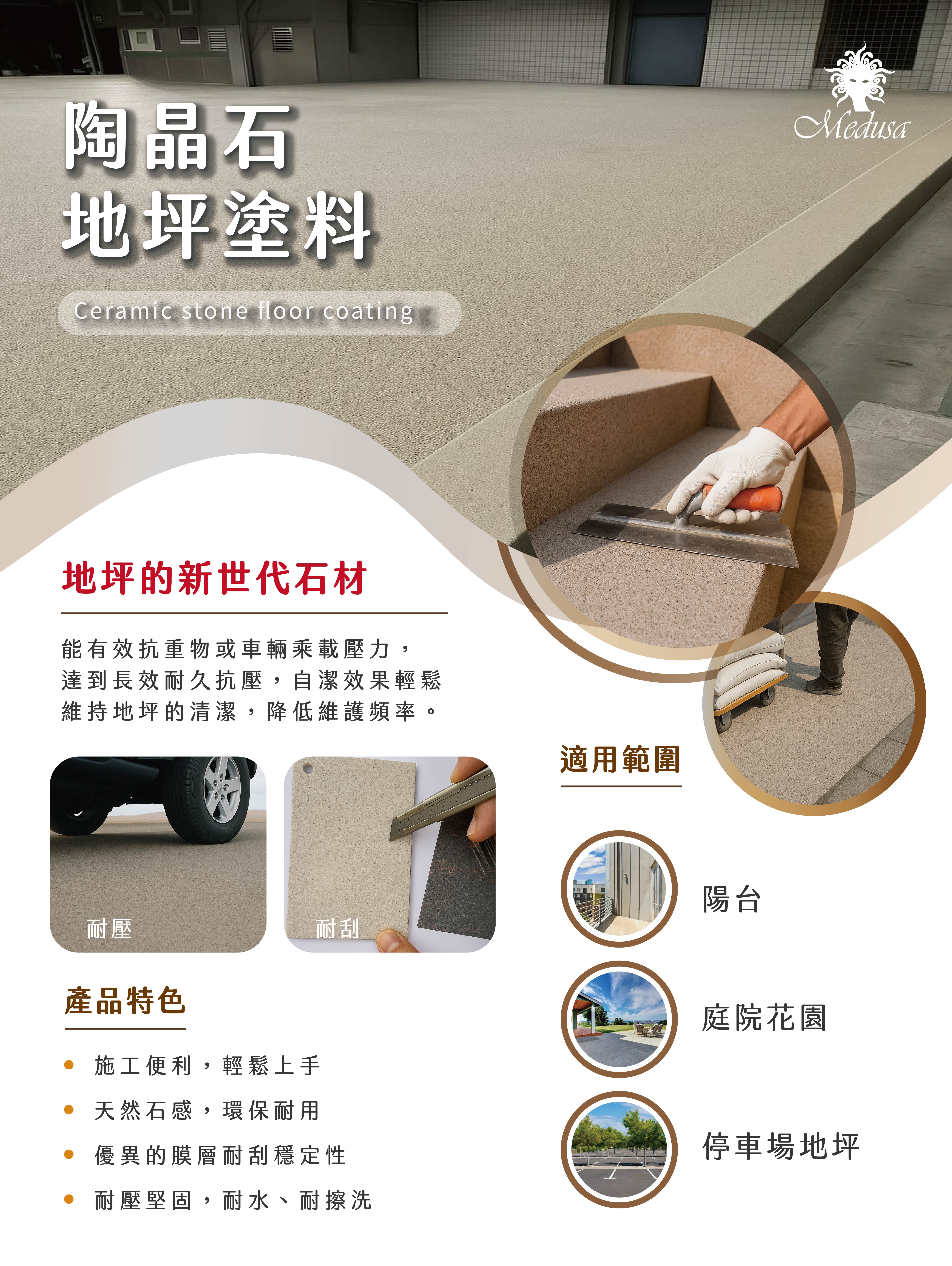
With advancements in materials technology, a new generation of floor coatings has emerged in recent years, offering both durability and environmental friendliness as alternatives to PU and epoxy flooring.
Key Features:
Abrasion-resistant, pressure-resistant, and scratch-resistant: High surface hardness, capable of withstanding heavy vehicle and pedestrian wear.
Water-resistant and scrub-resistant: High water resistance and chemical cleaning resistance, keeping the floor clean and shiny.
Slip-resistant and safe: Surface roughness can be adjusted to enhance slip resistance.
Easy to apply: Can be applied directly to concrete or overlaid on existing surfaces.
Environmentally friendly formula: Low VOC, solvent-free odor, aligning with green building material trends.
Noise-free: After application, it eliminates sharp friction noise when vehicles enter, exit, or turn, maintaining a smooth and quiet environment.
Applications: Parking lot floors, gardens, balconies, terraces, office walkways, public spaces, etc.
Table 4 Comparison of Product Advantages
|
材料名稱 |
耐久年限 |
耐磨性 |
耐水性 |
維護頻率 |
適用環境 |
|
PU防水塗料 |
約5~8年 |
★★★ |
★★★ |
每5年需補修 |
屋頂、陽台 |
|
Epoxy地坪 |
約5~7年 |
★★★★ |
★★★ |
每3~5年需翻新 |
室內地坪 |
|
陶晶石地坪塗料(華彩) |
10年以上 |
★★★★★ |
★★★★★ |
幾乎免維護 |
停車場、庭院、陽台 |
Ceramic stone floor coatings use a high-polymer inorganic structure to create a robust and weather-resistant protective layer, not only replacing the application range of PU and epoxy, but also providing a comprehensive upgrade in wear resistance, weather resistance and environmental protection.
PU waterproofing is widely popular due to its ease of application and affordability, but its lifespan and weather resistance are ultimately limited.
For a longer-lasting, low-maintenance, and highly durable building protection solution, Hua tsai Coatings' "Ceramic Stone Floor Coating" is a more advanced choice.
With its superior wear resistance, pressure resistance, scratch resistance, and waterproofing properties, it perfectly replaces traditional PU and epoxy systems, providing modern buildings with a more sustainable and environmentally friendly flooring solution.
Whether it's roof waterproofing renovation, parking lot repair, or courtyard/balcony upgrades, choosing Huacai Coatings is the first step towards making your buildings "more durable and sustainable."
☎電話 ▏ 07-365-6297
地址 ▏ 高雄市楠梓加工出口區東三街4號
網站 ▏ https://reurl.cc/mYlgMY
Line ▏ https://reurl.cc/MOaYGn
延伸閱讀:華彩塗料 耐候性塗裝建材最佳解決方案
延伸閱讀:華彩塗料落實ESG 獲2025台灣精品獎
延伸閱讀:台灣精品獎-愛循環多彩紋理仿石塗料
