




Airless vs Air vs Plural Spray Machines Guide | Medusa Paint
Poor spray results usually come not from the applicator's skill, but from a mismatch between the spray machine and the coating. If you judge only by output speed and use an airless sprayer for everything, the color flecks in stone-effect and multicolor coatings often get broken up and nozzles clog easily. In practice, you need to weigh "coating viscosity and aggregate particles + project area and schedule" together to choose correctly between airless, air, and plural-component spray machines.
Key Takeaways
- Spray machines fall into three categories: airless sprayers (high-pressure pump, typical operating pressure around 3,000 psi), air spray systems (atomized by an air compressor, atomizing pressure around 50–75 psi), and automatic/plural-component sprayers (A and B components delivered separately and mixed at the gun).
- Airless spraying uses a gun distance of about 30–45 cm (12–18 in), with high output and productivity—suited to large-area exterior latex paint, elastomeric coatings, and anti-corrosion coatings on steel structures.
- Air spraying uses a gun distance of about 15–20 cm (6–8 in), with fine atomization and adjustable texture—suited to stone-effect paint, multicolor coatings, and finish surfaces where appearance matters.
- High-end plural-component units reach a maximum fluid pressure of 3,500 psi and can heat material to about 88°C, used for fast-curing materials such as polyurea and spray polyurethane foam.
- Medusa Paint's stone-effect coatings are applied with an air-driven pressure-feed system—"air compressor + pressure pot / cola keg + spray gun"—which delivers material at low pressure and keeps the color flecks intact.
- A pressure pot delivering at about 25–30 psi provides a stable feed; the key is matching atomizing air pressure with nozzle size.
- 5 factors for choosing a machine: coating type, viscosity and aggregate size, project area, schedule, and on-site power and overspray control.
- Airless and plural-component units are high-pressure fluid equipment: never point the gun at anyone or block the nozzle with your hand, to prevent high-pressure injection injuries.
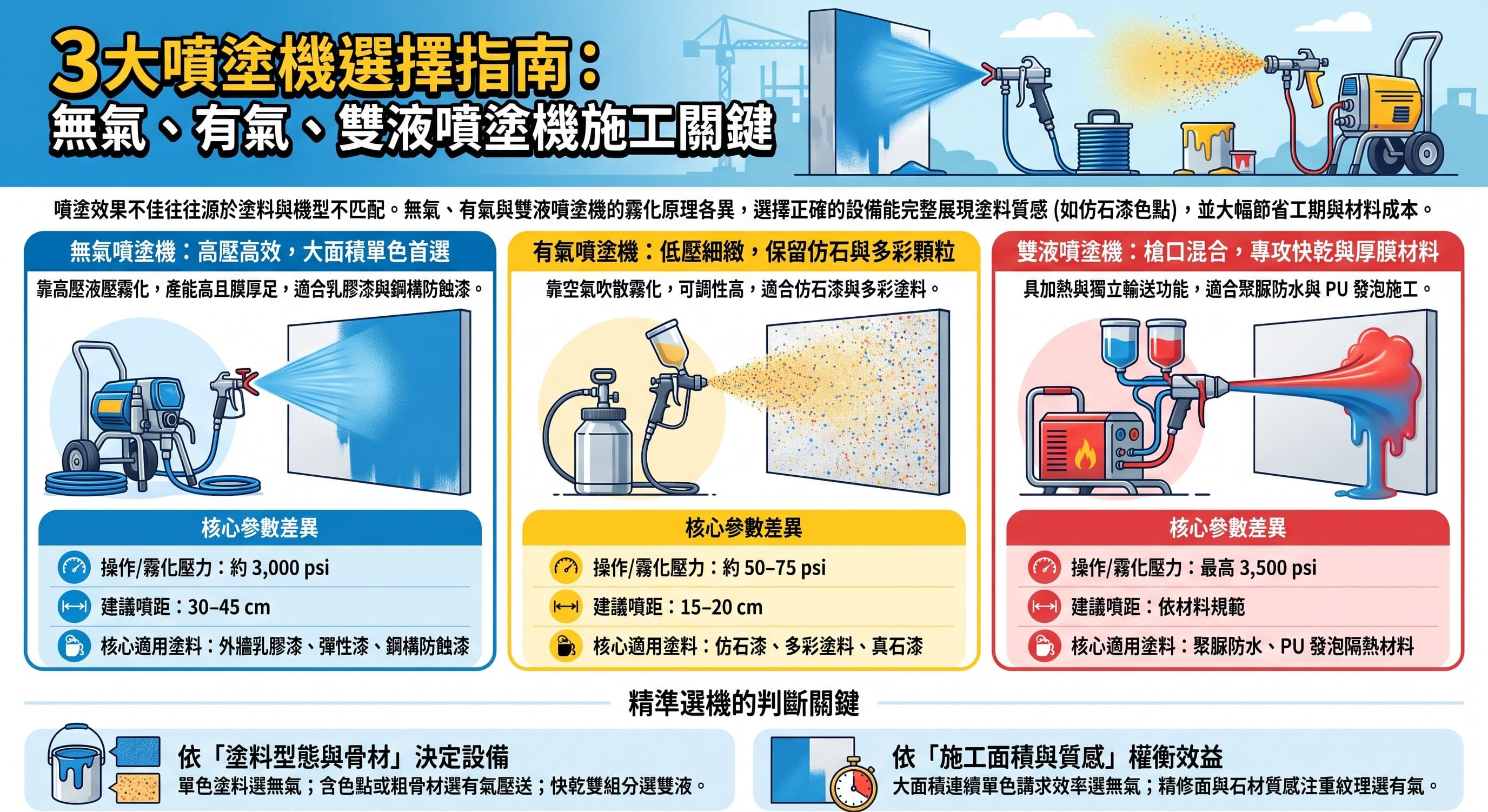
In Taiwan's humid, rainy climate with high levels of airborne dust, exterior wall coating is not just about attractive color—it also demands uniform film thickness and stable adhesion. For applicators and contractors, the same bucket of coating applied with different spray machines can produce dramatically different results: insufficient film build, smeared color flecks, sagging, and clogged nozzles all end up as rework and customer complaints.
As a professional architectural coatings specialist, Medusa Paint (Hua Tsai) wants you to know this: there is no single "best" spray machine—only the one best suited to a given coating and a given job site. This article covers the working principles, advantages, and applications of the three main categories—airless sprayers, air spray systems, and automatic/plural-component sprayers—and explains the equipment setup Medusa Paint actually uses for its stone-effect coatings, helping you pick the right machine before you arrive on site.
1. What Types of Spray Machines Are There? How Airless, Air, and Plural-Component Sprayers Differ in Principle
Many applicators choose equipment by habit—"use whatever's on hand." But the three types of spray machines atomize coatings in completely different ways, which determines what coatings they can spray and what finish they produce.
Simply put: airless uses "hydraulic pressure" to break up the coating, air spray uses "air" to blow it apart, and plural-component equipment mixes two reactive materials only at the gun. Understand the principle, and you won't reach for the wrong tool.
Comparing How the Three Machine Types Atomize Coatings
An airless sprayer uses a pump to pressurize the coating to high pressure; as the coating passes through a tiny nozzle orifice, the sudden pressure drop breaks it into a mist, with no compressed air involved in atomization. According to coatings consultancy KTA-Tator, airless spraying typically operates at around 3,000 psi, with orifice sizes such as 0.023 in, and pump ratios of 30:1, 45:1, 60:1, and so on.
An air spray system (conventional air spray) uses an air compressor to supply compressed air, which blows the coating apart and atomizes it at the air cap; the coating can be fed from a gun cup, a pressure pot, or a large pressure tank. KTA-Tator notes that atomizing pressure is typically about 50–75 psi, with pot pressure around 25–30 psi.
An automatic/plural-component sprayer delivers the A and B components through separate lines and proportioning pumps, mixing them only at the gun as they are sprayed. It suits materials that cure quickly once mixed and cannot be pre-mixed and sprayed at leisure.
| Dimension | Common Mistake / Problem | Correct Approach / Medusa Solution | Quantified Indicator |
|---|---|---|---|
| Atomization method | Assuming "more pressure is better" and spraying every coating at high pressure | Airless breaks up coating with hydraulic pressure; air spray atomizes with compressed air; plural-component mixes at the gun before spraying | Airless approx. 3,000 psi; air spray atomizing approx. 50–75 psi |
| Gun distance | Gun too close to the wall causes sagging; too far causes dry spray | Adjust distance by machine type and keep the gun perpendicular to the wall | Airless approx. 30–45 cm; air spray approx. 15–20 cm |
| Material feed | Repeatedly refilling a small cup; interruptions leave lap marks | Switch to a pressure pot or pressure tank for continuous feed on large areas | Pressure pot delivery approx. 25–30 psi |
| Material type | Pre-mixing two-component material before spraying; it cures in the pot and is wasted | Use proportioning pumps and mix-at-gun for fast-curing two-component materials | High-end plural units: max fluid pressure 3,500 psi |
The difference between the three spray machine types is not "strong versus weak" but how they atomize. Airless relies on hydraulic pressure, air spray on air, and plural-component on mixing at the gun—and the principle determines which coatings each suits. Before choosing, ask: does this coating need to be "forced apart," "blown apart," or "reacted on site"?
2. What Are the Advantages of Airless Sprayers? Why Large Exterior Walls and Factory Steel Structures Use Them
Airless sprayers are the most common equipment for industrial coating and large-scale building projects. KTA-Tator notes that airless is the most common spray method on industrial structures, suited to large, relatively simple surfaces where high production is the goal.
For contractors, the value of airless spraying lies in "high output, sufficient film build in one pass, and no compressor air lines to drag around"—especially valuable under schedule pressure.
4 Key Advantages of Airless Sprayers
First, high productivity: large output, suited to continuous large areas such as entire building façades, factory roofs, and steel structures. Second, it handles medium- to high-viscosity coatings: Graco's technical literature states that airless and air-assisted airless suit medium- to high-viscosity fluids. Third, greater film build per pass, which can reduce the number of coats. Fourth, less overspray than conventional air spray, with higher transfer efficiency.
Applications and Limitations of Airless Sprayers
Common applications: exterior latex and elastomeric paints, waterproof coating topcoats, anti-corrosion primers and topcoats for steel, and large wall areas in factories and parking structures.
Limitations: the finish is generally less refined than air spray; high pressure breaks up the colored particles in multicolor coatings, and coarse aggregates easily clog small-orifice nozzles. In addition, high-pressure fluid injected into the skin causes severe injection injuries—always engage the trigger safety lock and never touch the nozzle during operation.
| Dimension | Common Mistake / Problem | Correct Approach / Medusa Solution | Quantified Indicator |
|---|---|---|---|
| Suitable area | Forcing an airless unit onto small sites with many corners wastes material and makes edges hard to finish | Prioritize for large, simply configured walls and steel structures | Gun distance approx. 30–45 cm; continuous large-area application |
| Suitable coatings | Spraying multicolor or stone-effect coatings airless breaks up the color flecks | Single-color coatings such as latex, elastomeric, and anti-corrosion paints | At a 30:1 pump ratio, 50 psi air input yields approx. 1,500 psi output |
| Nozzle selection | Worn nozzles not replaced, distorting the fan pattern and film thickness | Select orifice size by coating viscosity and fan width; check wear regularly | Example orifice size: 0.023 in |
| Operating safety | Removing the nozzle for cleaning without relieving pressure, causing injection injury | Relieve pressure before stopping, lock the trigger safety, never point the gun at anyone | Operating pressure up to approx. 3,000 psi |
Airless sprayers are the efficiency tool for large-area, single-color coating, with high productivity and good film build. But they are unsuitable for multicolor and stone-effect coatings containing color flecks, and as high-pressure equipment they require strict safety practices.
3. What Are Air Spray Systems Best For? Why Stone-Effect and Multicolor Coatings Use an Air Compressor + Pressure Pot
Air spray systems (conventional air spray) are slower than airless, but offer fine atomization and high adjustability, making them the first choice when finish quality matters. Graco's technical literature states that air spray suits low- to medium-viscosity fluids for products requiring a high-quality or decorative finish.
For materials such as stone-effect and multicolor coatings, where the appearance is the selling point, air spray lets you control fleck size and texture distribution by combining air pressure, nozzle size, and gun distance.
Feed Options for Air Spray: Gravity Cup, Pressure Pot, Pressure Tank
According to the article "Types and Uses of Spray Guns" on Medusa Paint's official website, spray guns can be classified as siphon, gravity, pressure-feed, and electric. The pressure-feed type is supplied from a separate pressure pot; its advantages are large capacity, consistent atomization, and suitability for large areas, while its drawbacks are that color changes and cleaning take more time. Electric spray guns offer limited control over particle size in multicolor stone-effect coatings and consume more material.
This is why exterior stone-effect projects mostly use an "air compressor + pressure pot" pressure-feed setup: the compressor supplies both the atomizing air and the air that pressurizes the pot, and the coating is delivered to the gun steadily at relatively low pressure without passing through a high-pressure pump, so the color fleck particles stay intact.
Applications of Air Spray Systems
Stone-effect coatings, multicolor coatings, aggregate coatings such as real-stone paint, localized decorative-coating effects, and finish surfaces such as door and window frames and moldings. HVLP (high volume, low pressure) guns are a low-overspray version of air spray; Graco states that air pressure at the air cap must not exceed 10 psi, with higher transfer efficiency than conventional air spray.
| Dimension | Common Mistake / Problem | Correct Approach / Medusa Solution | Quantified Indicator |
|---|---|---|---|
| Appearance control | Inconsistent fleck size, or areas smeared into a solid patch | Fine-tune texture with air pressure, nozzle size, and gun distance; spray a test panel first | Gun distance approx. 15–20 cm |
| Feed stability | Frequent small-cup refills cause fleck density to vary | Continuous feed from a pressure pot, with the gauge holding steady at the set value | Pressure pot approx. 25–30 psi |
| Overspray control | Excessive atomizing pressure causes heavy overspray and wasted coating | Lower air pressure as far as atomization allows; switch to HVLP if needed | HVLP air cap pressure ≤ 10 psi |
| Cleaning and color change | Equipment not cleaned at end of day; residue cures in the pot and lines | At day's end, immediately relieve pressure, empty material, and flush with clean water | Clean at least once per working day |
The strength of air spray is control: fine atomization, adjustable texture, and intact color flecks. These are exactly the qualities stone-effect and multicolor coatings need, and the reason exterior stone-effect projects commonly use an air compressor and pressure pot pressure-feed system.
4. Where Are Automatic/Plural-Component Sprayers Used? Fast-Curing Application of Polyurea, PU, and Epoxy
Plural-component sprayers are dedicated equipment for materials that cure quickly once the A and B components are mixed. If you pre-mix such material and spray it with an ordinary sprayer, it may start reacting in the bucket or hose, ruining the whole batch or even seizing the equipment.
Plural-component units meter the A and B components separately with proportioning pumps, deliver them through hoses, and mix them only at the gun; they can also heat the material to reduce viscosity. They are essential equipment for polyurea waterproofing, spray polyurethane foam insulation, and similar work.
Advantages of Plural-Component Sprayers
Accurate ratios, spray-as-you-mix, and no pot-life pressure; heating capability, thick-film application, and fast curing that can shorten schedules. Taking the Graco Reactor brochure as an example, the electric E-Series has a maximum fluid pressure of 2,000 psi (3,500 psi for E-XP models) and a maximum material heating temperature of 88°C; the E-30 outputs about 13.6 kg per minute.
Applications and Barriers to Entry for Plural-Component Sprayers
Common applications: polyurea waterproofing for roofs and water tanks, spray polyurethane foam insulation, and some industrial flooring and anti-corrosion coatings. The barriers are high equipment investment, the need for dedicated operators and maintenance, and strict requirements for temperature, humidity, and substrate moisture content. Most architectural exterior coatings are single-component waterborne materials and do not require plural-component equipment.
| Dimension | Common Mistake / Problem | Correct Approach / Medusa Solution | Quantified Indicator |
|---|---|---|---|
| Material suitability | Buying a plural unit for single-component waterborne coatings—a wasted investment | Use only for fast-curing two-component materials (polyurea, PU foam) | Reactor E-XP max 3,500 psi |
| Mix ratio | A/B ratio deviation leaves the film uncured or brittle | Meter with proportioning pumps; verify ratio and test-spray before starting | Follow the material manufacturer's specified ratio |
| Temperature control | No heating in winter: high viscosity and poor mixing | Preheat the unit and heated hoses to the material's recommended temperature | Max material temperature approx. 88°C |
| Productivity | Hand-rolling polyurea over large areas extends the schedule | Spray thick film continuously with a plural-component unit | E-30 approx. 13.6 kg per minute |
Plural-component sprayers are dedicated equipment for fast-curing materials, offering accurate ratios, thick fast-drying films, and short schedules, at the cost of high investment and operating requirements. Typical architectural exterior coatings and stone-effect coatings are single-component and do not need a plural-component unit.
5. How Is Medusa Stone-Effect Coating Sprayed? Equipment Setup with Air Compressor, Pressure Pot, Cola Keg, and Spray Gun
On the job site, Medusa Paint's stone-effect coatings are applied with an air-driven pressure-feed system consisting of an air compressor, a pressure pot (or a larger-capacity cola keg), and a spray gun. The purpose of this setup is to deliver coating containing color fleck particles steadily at low pressure, so the sprayed texture closely resembles natural stone.
The following explains the role of each piece of equipment and how the system is assembled. Set actual air pressures and nozzle sizes according to the technical data for each Medusa product and the results of on-site test panels.


The Role of Each of the Four Pieces of Equipment
Air compressor: the air source for the entire system—one line supplies the spray gun for atomization, and another passes through a regulator to pressurize the pressure pot. Pressure pot: a sealed material container fitted with a regulator and pressure gauge on top, pushing coating to the gun at a steady pressure; suited to small and medium areas or touch-ups. Cola keg: a large-capacity pressure tank converted from a stainless-steel keg, also fed by air pressure; its larger capacity reduces refill interruptions on large façades, which cause color variation and lap marks. Spray gun: a pressure-feed gun that controls fleck size and distribution by adjusting nozzle size and air pressure.
5 Steps for On-Site Operation
1. Confirm the substrate has completed the preceding coats, such as the high-adhesion primer and intermediate coat. 2. Stir the coating thoroughly according to the product instructions, pour it into the pressure pot or cola keg, and tighten the lid. 3. Set the pot feed pressure and gun atomizing pressure separately, and check the fleck effect on a test panel first. 4. Hold the gun perpendicular to the wall, maintaining a constant distance and travel speed, with each pass overlapping about half the fan width. 5. At the end of work, immediately relieve pressure and clean the tank, hoses, and spray gun.
| Dimension | Common Mistake / Problem | Correct Approach / Medusa Solution | Quantified Indicator |
|---|---|---|---|
| Air source | Undersized compressor causes fluctuating pressure and uneven flecks | Use a compressor with sufficient air delivery and install a water filter | Gauge needle steady, not fluctuating |
| Material container | Using only a small pressure pot on large areas, stopping frequently to refill | Pressure pot for small areas; switch to a cola keg for large areas | Fewer refill interruptions mean lower risk of lap marks |
| Spray technique | Angled gun and uneven speed cause inconsistent fleck density | Gun perpendicular to the wall, constant speed, overlapping passes | Overlap each pass by approx. 50% of fan width |
| Result verification | Spraying the wall without a test panel; fleck size doesn't match the sample | Spray a test panel before production and proceed after owner approval | At least 1 test panel per batch |
Medusa stone-effect coatings are applied with an air-driven pressure-feed system of an air compressor, pressure pot or cola keg, and spray gun, feeding steadily at low pressure to preserve the color fleck particles. The keys are a stable air source, continuous feed, consistent technique, and test panels first—get all four right and the stone texture will be consistent.
6. How to Choose a Spray Machine? 5 Factors for Matching the Machine to the Coating, Area, and Schedule
The most common result of choosing the wrong spray machine is rework: wrong flecks mean respraying an entire wall, insufficient film build means extra coats, and material curing inside the hoses means taking the machine apart to clean it. These costs are often far higher than choosing the right equipment in the first place.
The following 5 factors can help applicators and contractors decide on the machine type at the quoting and material-preparation stage.
5 Factors for Choosing a Machine
1. Coating type: airless for single-color latex and elastomeric paints; air pressure-feed for stone-effect, multicolor, and aggregate coatings; plural-component for polyurea and PU foam. 2. Viscosity and aggregate size: avoid small-orifice high-pressure nozzles for particle-laden materials. 3. Project area: for large single-color areas, productivity comes first; for feature surfaces, finish quality comes first. 4. Schedule: fast-curing two-component materials can shorten the schedule, but budget for the equipment and personnel costs. 5. Site conditions: power supply, space for the compressor, and overspray protection for nearby vehicles and residents.
| Dimension | Common Mistake / Problem | Correct Approach / Medusa Solution | Quantified Indicator |
|---|---|---|---|
| Large single-color areas | Coating an entire façade with a small-cup air gun drags out the schedule | Airless sprayer | Gun distance approx. 30–45 cm; good film build per pass |
| Stone-effect / multicolor | Using airless or electric guns breaks up flecks and leaves uneven texture | Air compressor + pressure pot / cola keg + pressure-feed spray gun | Pressure pot feed approx. 25–30 psi |
| Fast-curing two-component | Pre-mixing before spraying; material cures in the pot and is wasted | Plural-component proportioning sprayer | Max fluid pressure 2,000–3,500 psi |
| Detail work and moldings | Spraying with a wide fan at high pressure; overspray contaminates windows and doors | Air spray or HVLP gun + thorough masking | HVLP air cap pressure ≤ 10 psi |
Choosing a machine isn't about which is most expensive or fastest, but about the coating, area, schedule, and site conditions. The rule is simple: airless for large single-color areas, air pressure-feed for stone-effect and multicolor coatings, plural-component for fast-curing materials, and HVLP for detail surfaces.
Frequently Asked Questions (FAQ)
- Q1. What is the biggest difference between airless and air spray machines?
- The atomization principle. An airless sprayer pumps the coating to about 3,000 psi and it breaks into a mist as it passes through a small nozzle; an air spray system uses an air compressor to supply air at about 50–75 psi that blows the coating apart. The former offers high productivity; the latter fine atomization and a controllable finish.
- Q2. Why does stone-effect paint perform poorly with an airless sprayer?
- Stone-effect and multicolor coatings contain colored particles or aggregates. High-pressure pumps and small-orifice nozzles tend to break up the color flecks or clog, so the texture cannot achieve a stone-like look. That is why an air pressure-feed system with an air compressor and pressure pot is usually used, feeding at low pressure to preserve the particles.
- Q3. How thick a film can air spray achieve?
- Film build per pass with air spray is usually lower than with airless spray, so thickness is built up over multiple coats. The actual thickness per coat and number of coats should follow each coating's technical data sheet; spraying one heavy coat is not recommended, as it can cause sagging and a surface that is dry on top but not cured underneath.
- Q4. Can stone-effect coating be sprayed directly onto the exterior wall of an older building?
- Not recommended. Leaks, cracks, and loose substrate must be dealt with first, followed by a high-adhesion primer and intermediate coat, and only then the stone-effect main coat and protective topcoat. The spray equipment only handles the final forming; substrate preparation determines durability.
- Q5. The flecks suddenly got bigger or smaller mid-job—how do I troubleshoot?
- Check the pressure gauges first: an unstable air source or a change in pot feed pressure will both affect the flecks. Next, check whether the nozzle is worn or partially clogged, whether the coating has settled and needs re-stirring, and whether gun distance and travel speed are consistent. After fixing the issue, confirm on a test panel before returning to the wall.
- Q6. How do I choose between a pressure pot and a cola keg?
- Both feed material by air pressure. A pressure pot has smaller capacity and is easy to move, suited to touch-ups and small areas; a cola keg has larger capacity, suited to continuous application on large façades, reducing the lap marks and color variation caused by stopping to refill.
- Q7. Should a contractor buy a plural-component sprayer? How should the budget be considered?
- If you mainly do exterior coatings and stone-effect work, the materials are mostly single-component and you don't need a plural-component unit. Equipment investment, maintenance, and operator training costs are high, making it better suited to specialist teams doing polyurea waterproofing or PU foam long-term; for occasional jobs, consider subcontracting or renting.
- Q8. Can homeowners spray stone-effect coating themselves as a DIY project?
- Not recommended. The stone effect depends on coordinated settings between the air compressor, pressure pot, and spray gun, plus spraying technique; non-professionals often end up with uneven flecks, sagging, and overspray contamination. Electric spray guns offer limited particle control with multicolor coatings, so even small touch-ups are best referred to a professional application team.
7. Choose Medusa Paint (Hua Tsai) to Give Your Building Outstanding Long-Term Value
Achieving a Win-Win-Win of Low Carbon, Aesthetics, and Weather Resistance
Medusa Paint replaces the look of natural stone with stone-effect coatings, reducing the load on building façades, and incorporates recycled materials through I-recycled Coating. Every 1 kg of recycled material used reduces CO₂ emissions by 1.27 kg, and the products have passed ISO 14067 carbon footprint verification and Recycled Green Product certification, giving exterior walls stone-like texture, weather resistance, and low-carbon value together.
Systematic Professional Integration That Solves Application Pain Points
Medusa Paint provides a complete system—from high-adhesion primer and textured intermediate coat to stone-effect main coat and protective topcoat—and explains the spray equipment and operating points suited to each step. Applicators and contractors don't have to work out material and equipment combinations on their own, lowering the risk of trial and error and rework; according to brand data, overall application costs can be reduced by up to 50%.
Enhancing Asset Value and Sustainable Aesthetics
Medusa Paint's I-recycled Multicolor Textured Stone-Effect Coating was recognized with a 2025 Taiwan Excellence Award, giving both new developments and older-building renovations a stone-grade façade while responding to ESG procurement requirements; according to brand data, it can save up to 40% in carbon fees. For contractors, this is also a persuasive differentiator when pitching to owners.
| Dimension | Common Mistake / Problem | Correct Approach / Medusa Solution | Quantified Indicator |
|---|---|---|---|
| Finish quality | Mismatched tools and materials distort the stone-effect texture | Air pressure-feed system paired with Medusa stone-effect coatings preserves the color flecks | Test panel for every batch before production |
| Low-carbon emissions reduction | Façade materials lacking carbon footprint data make ESG responses difficult | Use low-carbon coatings verified to ISO 14067 | Every 1 kg of recycled material cuts 1.27 kg CO₂ |
| Application cost | Incomplete material systems cause problems between steps and rework | Complete primer, intermediate coat, main coat, and topcoat system | Application costs reduced by up to 50% |
| Brand trust | Owners doubt that coatings can replace stone | Pitch with the Taiwan Excellence Award and project references | 2025 Taiwan Excellence Award |
Choosing the right spray machine is half of a successful stone-effect project; the other half is choosing the right material system. With low-carbon stone-effect coatings, a complete coating sequence, and application equipment guidance, Medusa Paint helps applicators and contractors deliver consistent stone texture that balances aesthetics, weather resistance, and sustainable value.
Contact Information
☎
Phone ▏ +886-7-365-6297
Address ▏ No. 4, East 3rd Street, Nanzih Export Processing Zone, Kaohsiung City, Taiwan
Website ▏ https://www.medusa-paint.com.tw/
LINE ▏ https://reurl.cc/MOaYGn
