




The Convenient Alternative to Traditional EPOXY — Ceramic Crystal Stone Floor Coating: 5 Key Advantages of Faster Application and Superior Durability
Traditional EPOXY floor coatings are complex to apply, emit strong odors, and take a long time to cure — largely due to their two-component formula and high solvent content.
Relying on traditional EPOXY alone often leads to recurring issues with wear resistance and appearance, as the high technical requirements leave room for application errors.
In practice, the only way to truly resolve floor renovation pain points is to combine a low-VOC waterborne Ceramic Crystal Stone Floor Coating with a streamlined application method.
Quick Summary: Ceramic Crystal Stone Floor Coating vs. Traditional EPOXY
• Significantly faster application: Two-component formula that only requires mixing before use — no complex ratio calibration — dramatically shortens application time.
• Low-VOC eco-friendly formula: Water-based coating free of benzene, toluene, and other harmful solvents, improving the work environment and meeting indoor air quality standards.
• Superior abrasion resistance: Nano-ceramic particles deliver high surface hardness, excellent scratch and pressure resistance, and a longer service life than traditional EPOXY.
• Versatile aesthetic options: Multiple color palettes and crystal-stone textures, suitable for factories, offices, parking facilities, medical institutions, and more.
• No need to remove existing flooring: Can be applied directly over existing floors (where conditions permit), saving demolition and debris removal costs.
The Convenient Alternative to Traditional EPOXY — Ceramic Crystal Stone Floor Coating: 5 Key Advantages of Faster Application and Superior Durability
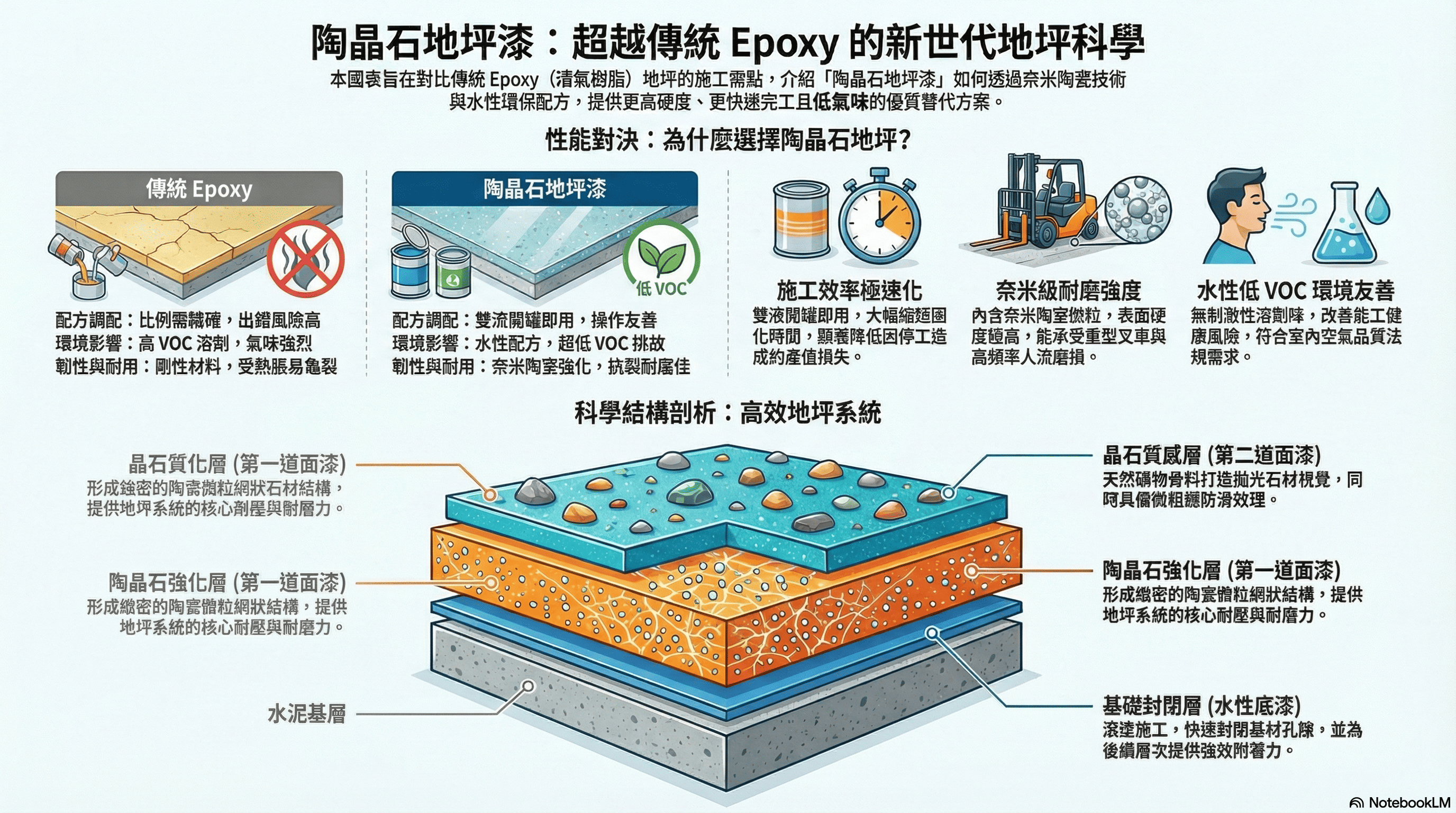
Introduction: The Old Problem with Floor Renovation — Time for a Better Solution
In Taiwan's high-humidity, high-rainfall, and industrial-dust-heavy environment, the challenges of floor coating have never eased. Whether in factories, parking facilities, offices, or medical institutions, the wear resistance, chemical resistance, and aesthetic quality of a floor directly affect a space's useful life and maintenance costs.
For years, traditional EPOXY (epoxy resin) floor coatings have been virtually the only professional-grade choice. However, as building materials technology continues to advance, the shortcomings of EPOXY — complex application, strong odors, lengthy curing times, and cracking and delamination — have led more and more building owners and contractors to seek better alternatives.
As a professional architectural coatings expert, Hua Tsai (Medusa Paint) is here to tell you: the Ceramic Crystal Stone Floor Coating was developed specifically to address all of these issues. Combining a waterborne low-VOC formula with nano-ceramic technology, it maintains excellent wear and chemical resistance while dramatically reducing application difficulty and environmental impact — making it the ideal choice for modern floor coating.
Section 1: Five Major Pain Points of Traditional EPOXY
EPOXY floor coatings have been in use in Taiwan for many years, with well-documented advantages: strong adhesion, high hardness, and chemical resistance. However, as application environments become more complex and owner requirements more diverse, the limitations of traditional EPOXY in terms of application convenience and environmental friendliness have become increasingly apparent, making it difficult to meet the demands of modern construction projects.
1. Two-Component Formula: High Risk of Mixing Errors
Traditional EPOXY consists of a base resin and a hardener that must be mixed in strict proportions before application. If the ratio deviates, the hardness, adhesion, and chemical resistance of the cured film all suffer significantly. In severe cases, the coating may never fully cure, leaving a permanently tacky surface and rendering the entire batch of material unusable.
2. Irritating Solvents: Health Risks for Applicators
Solvent-based EPOXY contains volatile organic compounds (VOCs). The strong, irritating odor during application is difficult for workers to tolerate, and prolonged inhalation poses potential health risks. When applied in enclosed spaces such as underground parking garages, forced-ventilation equipment must be installed, adding to project cost and time.
3. Long Curing Times: High Downtime Costs
Standard EPOXY floor coatings require many hours to reach foot-traffic strength and several days for full curing. For operating factories or commercial spaces, this means extended shutdowns, and the resulting production losses often far exceed the cost of the coating work itself.
4. Sensitivity to Temperature and Humidity
EPOXY's curing reaction is highly sensitive to temperature and humidity. In cold conditions, curing nearly stops; in high-humidity environments, surface blushing (a milky haze) can occur, reducing adhesion and causing a cloudy appearance on the film. Taiwan's damp winters significantly narrow the window for successful EPOXY application.
5. Brittle Cracking: High Long-Term Maintenance Costs
EPOXY films are inherently rigid materials. Temperature fluctuations, slight substrate movement, or vibration can cause the film to crack or even delaminate over large areas. With Taiwan's high summer ground temperatures, cracking in outdoor EPOXY floors is almost inevitable, leading to short maintenance cycles and high repair costs.
Table 1 Traditional EPOXY vs. Ceramic Crystal Stone Floor Coating — Pain Point Comparison
|
Dimension |
Common Issue / Traditional Method |
Improvement / Hua Tsai Solution |
Key Benefit |
|
Formula Mixing |
Requires precise base-to-hardener ratio; high risk of application errors |
Two-component formula: stir and apply; more user-friendly and error-resistant |
Significantly reduces application mistakes |
|
VOC Emissions |
High VOC solvent content; forced ventilation required |
Waterborne low-VOC formula; safer and more comfortable work environment |
Reduces health risks for applicators |
|
Curing Speed |
Takes a long time to reach foot-traffic strength; full cure takes days |
Faster curing; space can be returned to use sooner |
Effectively shortens downtime |
|
Application Conditions |
Heavily restricted by low temperature and high humidity; prone to defects |
Wider tolerance for temperature and humidity; greater adaptability |
Expands the range of suitable application conditions |
|
Durability |
Rigid film prone to cracking from temperature changes or vibration |
Nano-ceramic particles deliver better flexibility and wear resistance |
Reduces long-term maintenance costs |
The limitations of traditional EPOXY are not insurmountable — they call for a fundamentally redesigned solution. Ceramic Crystal Stone Floor Coating is precisely that: a next-generation product optimized across every aspect of formulation and application method, built on a thorough understanding of these pain points. Choosing the right material is what allows a floor investment to truly deliver long-term value.
Section 2: Core Technology of Ceramic Crystal Stone Floor Coating
Ceramic Crystal Stone Floor Coating's ability to replace traditional EPOXY rests on the organic integration of three core technologies: nano-ceramic particle reinforcement, a waterborne polyurethane (WPU) resin system, and a multi-layered crystal-stone texture formulation. Together, these technologies make the coating superior to traditional EPOXY across four dimensions: wear resistance, adhesion, environmental performance, and aesthetics.
1. Nano-Ceramic Particle Reinforcement Technology
One of the core components of Ceramic Crystal Stone Floor Coating is nano-ceramic particles, uniformly dispersed within a waterborne resin matrix. After the coating cures, these particles form a dense network structure that significantly increases surface hardness and delivers a higher abrasion coefficient. Compared to traditional EPOXY, the surface wear resistance is notably superior — particularly well-suited for factory floors with frequent forklift traffic and high-footfall commercial spaces.
2. Waterborne Polyurethane (WPU) Resin System
Ceramic Crystal Stone Floor Coating uses a waterborne polyurethane resin with water as the dispersing medium, eliminating the need for organic solvents. WPU resin has excellent flexibility, allowing the film to accommodate slight substrate deformation from thermal expansion and contraction without cracking. Its hydrolysis resistance and chemical resistance — including against dilute acids, dilute alkalis, machine oil, and cleaning agents — meet the requirements of most industrial and commercial spaces.
3. Crystal-Stone Texture Formula Design
Ceramic Crystal Stone Floor Coating is not only a functional coating but also a decorative floor system. Its distinctive crystal-stone texture comes from natural mineral aggregates and pigment dispersions in the formulation. Once cured, it produces a visual effect similar to polished stone while providing a slightly textured surface for anti-slip performance. Multiple color options are available, including dark grey, warm white, marble patterns, and metallic finishes, to meet the design needs of different spaces.
Table 2 Ceramic Crystal Stone Floor Coating — Core Technology Performance Comparison
|
Dimension |
Common Issue / Traditional Method |
Improvement / Hua Tsai Solution |
Key Benefit |
|
Surface Hardness |
Traditional EPOXY film has relatively limited hardness |
Nano-ceramic reinforcement delivers significantly higher surface hardness |
Superior scratch and pressure resistance |
|
Wear Resistance |
Traditional EPOXY wears faster; high-traffic areas show damage more quickly |
Nano-ceramic aggregates enhance wear performance |
Suitable for high-frequency-use environments |
|
Chemical Resistance |
Relatively weak resistance to dilute alkalis; prone to powdering with prolonged contact |
Resistant to dilute acids, alkalis, machine oil, and cleaning agents |
Broader applicability in chemical-exposure environments |
|
Anti-Slip Performance |
Smooth surface has insufficient wet anti-slip performance |
Slightly textured crystal-stone finish improves wet traction |
Reduces slip-and-fall risk in wet environments |
The technical advantages of Ceramic Crystal Stone Floor Coating do not stem from a single ingredient breakthrough, but from the synergistic integration of multiple technologies. It is precisely this systematic formulation design that allows it to simultaneously outperform traditional EPOXY in wear resistance, environmental performance, and aesthetics — making it the defining product of the next generation of floor coatings.
Section 3: Application Method Explained — Why It Outpaces Traditional EPOXY
The application efficiency advantage of Ceramic Crystal Stone Floor Coating comes from comprehensive optimization across both the formulation and the application process. For a factory floor project, traditional EPOXY application (including primer, mid-coat, topcoat, and curing) takes considerably longer, while a complete Ceramic Crystal Stone Floor Coating system can be finished in a fraction of the time, significantly reducing production downtime.
More importantly, the standardized application method reduces the chance of human error, allowing applicators with basic coating skills to achieve consistent quality — no longer dependent on the small pool of tradespeople with specialized EPOXY expertise.
1. Substrate Preparation
Substrate preparation is critical to the quality of any floor coating project. Before application, confirm that the floor moisture content is within the acceptable range, the surface strength is adequate, no grease residues are present, and any cracks have been filled with epoxy repair compound. Compared to EPOXY, Ceramic Crystal Stone Floor Coating tolerates a wider range of substrate moisture content, reducing the time spent waiting for the substrate to dry.
2. Primer Application
Apply the matching waterborne primer evenly by roller, sealing the substrate pores and enhancing topcoat adhesion. The waterborne primer cures faster, allowing the next coat to be applied sooner and significantly compressing inter-coat wait times.
3. Ceramic Crystal Stone Topcoat Application (2 Coats)
The topcoat is applied by trowel in two coats. The second coat can begin once the first coat has surface-dried. Once both coats have reached sufficient dry film thickness, foot traffic and vehicle access can resume much sooner than with traditional EPOXY — substantially reducing downtime losses.
Table 3 Ceramic Crystal Stone Floor Coating — Application Process Comparison
|
Dimension |
Common Issue / Traditional Method |
Improvement / Hua Tsai Solution |
Key Benefit |
|
Substrate Moisture Requirement |
EPOXY has strict moisture requirements; long wait for drying |
Ceramic Crystal Stone Coating tolerates a wider moisture range, shortening wait time |
Reduces substrate preparation wait time |
|
Primer Cure Speed |
Solvent-based EPOXY primer takes a long time to cure |
Waterborne primer cures faster; next coat can be applied sooner |
Tighter inter-coat scheduling |
|
Number of Topcoat Applications |
Traditional method typically requires multiple coats: primer + mid-coat + topcoats |
Primer + 2 coats of Ceramic Crystal Stone + clear protective topcoat |
Streamlined coat count; improved efficiency |
|
Return-to-Use Time |
Foot traffic and vehicles require extended waiting |
Faster curing means earlier return to normal use |
Downtime significantly shortened |
Improved application efficiency is one of the most competitively significant advantages of Ceramic Crystal Stone Floor Coating. For factories or commercial spaces that cannot afford extended downtime, the indirect economic benefit of shortening the shutdown period often far outweighs the material cost difference. Choosing efficiency means choosing competitiveness.
Section 4: Application Environments and Use Cases
The application range of Ceramic Crystal Stone Floor Coating is far broader than most people expect. With its outstanding wear resistance, chemical resistance, anti-slip performance, and aesthetic quality, it has been proven in industrial facilities, commercial spaces, parking structures, and more — gradually replacing traditional EPOXY as the mainstream choice. Through formulation adjustments, it can deliver customized performance combinations for different scenarios — a flexibility that traditional EPOXY cannot easily match.
1. Industrial Facilities and Warehouses
Frequent heavy forklift and pallet truck traffic subjects floors to extreme impact and abrasion. The high hardness and impact resistance of Ceramic Crystal Stone Floor Coating allows it to withstand daily heavy-duty operations without significant wear. For facilities with chemical spill risks, its resistance to dilute acids and alkalis provides effective protection.
2. Commercial Parking Facilities
Parking floors must withstand vehicle weight, tire friction, and water intrusion. The weathering resistance of Ceramic Crystal Stone Floor Coating makes it suitable for open-air top-level parking decks. Combined with reflective lane markings, it enhances both safety and visual appeal.
3. Offices and Commercial Spaces
The crystal-stone texture and rich color palette of Ceramic Crystal Stone Floor Coating can deliver a visual effect close to polished stone at a fraction of the cost. Its ultra-low VOC properties allow spaces to return to use quickly after application — making it ideal for offices or retail spaces undergoing renovation.
Table 4 Application Scenario Requirements and Solutions
|
Scenario |
Common Issue / Traditional Method |
Improvement / Hua Tsai Solution |
Key Benefit |
|
Industrial Facility |
Heavy equipment wear, chemical spills, high downtime cost |
High-hardness wear-resistant formula + chemical-resistant design; shorter project duration |
Extended floor service life; reduced maintenance frequency |
|
Commercial Parking |
Tire wear, water intrusion, aesthetic demands |
Weather-resistant topcoat + anti-slip formula; crystal-stone aesthetic |
Durable and attractive; longer maintenance intervals |
|
Office / Retail Space |
High aesthetic standards, low-VOC requirement, fast return to use |
Multi-color crystal-stone palette + low-VOC waterborne formula |
Rapid return to use after application; safe and comfortable environment |
Different environments demand different floor performance, and the advantage of Ceramic Crystal Stone Floor Coating lies in its high formulation flexibility — quickly adapting to different use conditions by adjusting aggregate particle size and adding functional additives. This ability to serve multiple scenarios from a single technology platform is precisely why it is replacing traditional EPOXY.
Section 5: Cost-Benefit Analysis — Superior Long-Term Return on Investment
Many building owners initially notice that Ceramic Crystal Stone Floor Coating is priced slightly higher per unit than basic solvent-based EPOXY. However, when installation costs, downtime losses, maintenance expenses, and service life are all factored in, the Total Cost of Ownership (TCO) of Ceramic Crystal Stone Floor Coating is typically more favorable.
1. Savings from Reduced Downtime
Reducing downtime is the most direct source of cost savings. The faster curing characteristics of Ceramic Crystal Stone Floor Coating allow factories and commercial spaces to resume operations sooner, cutting production or revenue losses from shutdown. For high-output facilities, this single saving often exceeds the material cost difference by a wide margin.
2. Lower Long-Term Maintenance Costs
Ceramic Crystal Stone Floor Coating offers superior wear and weathering resistance, a longer service life than traditional EPOXY, and a lower need for full refurbishment. Viewed over a long-term horizon, the savings on maintenance costs are substantial — making it a genuinely worthwhile long-term investment.
3. ESG Value: The Added Benefit of Low-Carbon Materials
As organizations increasingly prioritize ESG sustainability goals, choosing a waterborne low-VOC Ceramic Crystal Stone Floor Coating is not only a commitment to the application environment but also supports green procurement objectives and improves a building's environmental rating. Hua Tsai has achieved ISO 14067 carbon footprint verification, meaning every project contributes to the company's sustainable development goals.
Table 5 Ceramic Crystal Stone Floor Coating vs. Traditional EPOXY — Cost-Benefit Comparison
|
Dimension |
Common Issue / Traditional Method |
Improvement / Hua Tsai Solution |
Key Benefit |
|
Initial Investment |
Traditional EPOXY material cost is lower, but more coats and a longer project timeline are required |
Slightly higher material unit price, but fewer coats and greater efficiency; overall initial investment is comparable |
Initial costs are broadly equivalent |
|
Downtime Losses |
Slow curing means more shutdown days and higher indirect losses |
Fast curing, shorter downtime, significantly lower indirect losses |
Particularly impactful for high-output facilities |
|
Long-Term Maintenance |
Limited durability; higher refurbishment frequency |
Wear- and weather-resistant; longer service life, lower maintenance frequency |
Lower total long-term cost |
|
Environmental Benefit |
Solvent-based VOC is high; higher waste disposal costs |
Waterborne low-VOC; meets ESG green procurement requirements |
Supports sustainability goals; contributes to carbon tax savings |
Choosing a floor material is fundamentally a long-term financial decision. When the perspective shifts from 'unit material price' to 'total cost of ownership over the full service life,' the comprehensive advantages of Ceramic Crystal Stone Floor Coating become immediately clear. Achieving better floor quality at a lower long-term total cost — that is the rational investment logic.
Section 6: Frequently Asked Questions
Q1: Is the appearance of Ceramic Crystal Stone Floor Coating noticeably different from traditional EPOXY?
A: Yes. Ceramic Crystal Stone Floor Coating produces a crystal-stone texture similar to polished natural stone, which is significantly more refined than the plain solid colors typical of EPOXY. Multiple color options are available, including faux marble patterns and metallic grey tones. If a plain industrial look is preferred, matching options are available — the aesthetic quality is fully competitive with EPOXY.
Q2: Can Ceramic Crystal Stone Floor Coating be applied directly over an existing EPOXY floor?
A: It depends on the condition of the existing floor. If the existing film is intact and well-adhered, it can be sanded, cleaned, and overcoated without full removal — saving significant cost. If the existing film has extensive blistering or delamination, it is advisable to remove it down to the concrete substrate before applying the new system to ensure proper adhesion.
Q3: If localized color differences or scratches appear after application, is touch-up easy?
A: Touch-up is much easier than with traditional EPOXY. The waterborne formula means no full sanding is required; simply clean the affected area and apply touch-up coat with the original color. Any initial color difference will gradually blend. Hua Tsai maintains batch color records to ensure color consistency for all touch-up materials.
Q4: Will waterborne Ceramic Crystal Stone Floor Coating blister or peel if it comes into contact with standing water?
A: The waterborne polyurethane resin achieves industrial-grade water resistance. Once fully cured, the film can withstand prolonged contact with standing water without blistering or peeling. However, during the curing period after application (approximately 24 hours), direct rain exposure should be avoided to allow the film to cure completely.
Q5: Is the application cost higher than traditional EPOXY?
A: The material unit price is slightly higher, but because fewer coats are required and curing is faster, the overall application cost is competitive. Combined with the savings from reduced downtime, the long-term total cost is lower.
Q6: Can applicators with basic coating skills apply Ceramic Crystal Stone Floor Coating independently?
A: Yes. The two-component formula requires only basic mixing, the waterborne system needs no special ventilation, and standard trowel tools are used. Applicators with basic floor coating experience can get up to speed with a brief training session. Hua Tsai provides comprehensive technical support, including pre-application consultation, on-site technical guidance, and post-application quality verification.
Section 7: Choose Hua Tsai — Delivering Outstanding, Long-Lasting Value for Every Building
Having built a deep presence in Taiwan's architectural coatings market over many years, Hua Tsai (Medusa Paint) has consistently held 'low-carbon, beautiful, weatherproof, and professional' as its core values, continually developing innovative products that meet market needs. The launch of Ceramic Crystal Stone Floor Coating represents our commitment to a convenient, eco-friendly, and long-lasting floor solution.
7-1. Achieving a Triple Win: Low Carbon, Aesthetics, and Weathering Resistance
Hua Tsai's Ceramic Crystal Stone Floor Coating is a fully waterborne low-VOC product line. During application, it emits virtually no harmful gases, complying with Taiwan's indoor air quality regulations and green building material certification requirements. Compared to traditional solvent-based EPOXY, VOC emissions are significantly lower, substantially reducing health risks for applicators.
Aesthetically, the coating offers a range of crystal-stone textures and colors to meet diverse needs from industrial to commercial, functional to design-oriented environments. In terms of weathering resistance, UV stabilizers in the formulation prevent the film from fading or cracking in outdoor or semi-outdoor parking facilities, with a service life longer than traditional EPOXY.
Recognition through the 2025 Taiwan Excellence Award, ISO 14067 carbon footprint verification, and the Recycled Green Product Certification are tangible acknowledgments of Hua Tsai's progress on the ESG sustainability journey. Every 1 kg of Hua Tsai recycled material used reduces CO₂ emissions by 1.27 kg — supporting buildings in reaching carbon neutrality goals.
7-2. Systematic Professional Integration — Solving Application Pain Points
Hua Tsai offers more than just a coating product — it delivers a complete floor coating system solution. From pre-application substrate assessment and formulation selection, to on-site technical guidance and quality inspection during application, to warranty service and touch-up material support after completion, every step is backed by a professional team to ensure that quality meets expectations.
For different application scenarios, Hua Tsai provides customized formulation adjustments: self-leveling solutions for clean rooms requiring extreme flatness, heavy-load-resistant formulations for heavy industrial facilities — all covered, with one-stop-service support.
7-3. Enhancing Asset Value and Sustainable Aesthetics
Flooring is one of the highest-use, most immediately visible elements in any built space. A clean, durable, and attractive floor not only enhances the quality of the space but directly affects the market valuation of the building. Premium-floor commercial facilities consistently command stronger positioning in the leasing market compared to comparable properties.
Choosing Hua Tsai Ceramic Crystal Stone Floor Coating means incorporating a floor protection system aligned with ESG sustainability principles. As organizations increasingly prioritize carbon management and green procurement, specifying low-carbon materials verified by ISO 14067 is not only an environmental responsibility — it is an effective strategy for improving ESG ratings and attracting quality tenants or investors.
Table 6 Hua Tsai Ceramic Crystal Stone Floor Coating — Comprehensive Brand Performance Evaluation
|
Dimension |
Common Issue / Traditional Method |
Improvement / Hua Tsai Solution |
Key Benefit |
|
Environmental Certification |
Traditional EPOXY has no green building material certification; high VOC emissions |
ISO 14067 carbon footprint verified + Recycled Green Product Certification |
Significantly lower VOC; supports carbon tax savings objectives |
|
Quality Assurance |
Application quality depends on individual tradesperson skill; inconsistent results |
Systematic formulation + technical guidance; stable, consistent application quality |
High customer satisfaction; comprehensive after-sales support |
|
Market Recognition |
Traditional product with limited brand premium |
2025 Taiwan Excellence Award winner; ongoing international market promotion |
Brand reputation and recognition continue to grow |
|
Asset Enhancement |
Aging EPOXY reduces a space's appeal |
Crystal-stone aesthetics improve commercial facility image and rental competitiveness |
Helps strengthen competitive advantage in the leasing market |
Choosing Hua Tsai is not simply choosing a floor material — it is choosing a long-term building asset management partner. From technical support to environmental certifications, from product quality to after-sales service, Hua Tsai uses systematic professional integration to ensure that every floor project becomes an investment in building value, not merely an expenditure.
Contact Hua Tsai (Medusa Paint)
☎
Phone ▏ +886-7-365-6297
Address ▏ No. 4, East 3rd Street, Nanzih Export Processing Zone, Kaohsiung City, Taiwan
Website ▏ https://en.medusa-paint.com.tw/
Line ▏ https://reurl.cc/MOaYGn
Further Reading
Further Reading: Hua Tsai Implements ESG — Wins 2025 Taiwan Excellence Award (Economic Daily News)
Further Reading: Hua Tsai Eco-Friendly Recycled Coating Recognized Again — A Model for Low-Carbon Sustainable Materials (Economic Daily News)
Further Reading: Hua Tsai Coatings — Best Solution for Weather-Resistant Building Materials (Commercial Times)
