




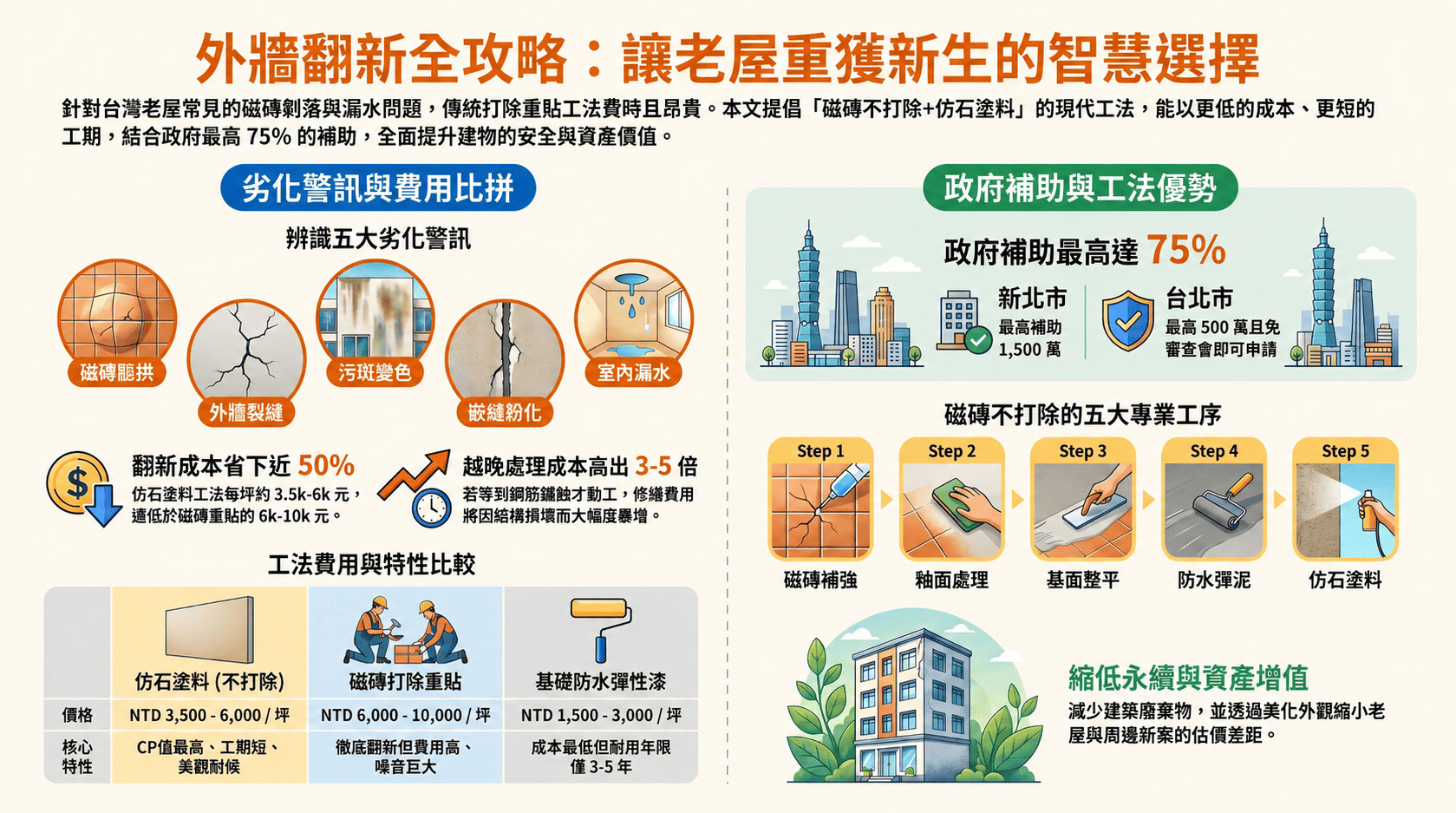
- Renovation cost: Stone-texture coating method from approximately NT$3,500–6,000 per ping; tile re-tiling NT$6,000–10,000+. The no-tile-removal method saves demolition and debris costs and has a shorter project timeline.
- No-tile-removal method: Old tiles are not removed — the coating is applied directly over the existing surface, saving significant debris removal cost and reducing scaffolding rental time, with far less disruption for residents.
- Waterproofing is the critical step: Renovation without simultaneously addressing waterproofing typically sees the problem recur within 1 to 2 years. A correct system covers: primer → waterproofing coat → stone-texture coat → weatherproof topcoat.
- Government subsidies available: Buildings aged 15 to 20+ years in most counties and cities qualify for maintenance and improvement subsidies. Taipei City offers up to 50% subsidy (max NT$5M); New Taipei City up to 75% (max NT$15M).
- Stone-texture coating durability: High-weathering-resistance resin formulations resist UV, resist soiling, and do not fade easily. Effective service life far exceeds standard flexible exterior paint, approaching the durability of tile when correctly applied.
- Whole-building renovation increases asset value: Renovation improves resident safety and can close the valuation gap between older and newer comparable properties in the same area — a high-return investment.
Exterior Wall Renovation Complete Guide: Spalling Tiles, Wall Mold & Water Leaks — Costs, Methods & Government Subsidies Explained, and How Stone-Texture Coating Gives Your Old Home a New Life
Introduction: Your Exterior Wall Is Quietly Eroding Your Property Value
'A tile fell off the building next door and nearly hit someone.' 'Every time it rains hard, the bedroom wall starts leaking.' 'The facade looks grey and decrepit — the whole building has aged twenty years.' These are the three most common complaints Taiwan homeowners post online when searching for exterior wall renovation advice.
In Taiwan's high-humidity, high-rainfall, earthquake-prone environment, building facades endure far more stress than most people realize. A home over 20 years old often has a tile disbonding rate that exceeds safety thresholds, and the waterproofing layer has long since failed. This isn't just an aesthetic issue — it's a safety issue. Falling tiles carry real legal liability.
As a professional architectural coatings expert, Hua Tsai (Medusa Paint) handles a large volume of old-building exterior wall renovation projects every year. We understand the confusion homeowners face: which method is right, whether the quote is reasonable, and whether any subsidies are available. This guide answers all of those questions.
1. What's Wrong with Your Exterior Wall? Recognize These 5 Warning Signs
Exterior wall deterioration doesn't happen overnight — it's the cumulative result of years of weathering, moisture penetration, and thermal cycling. Most homeowners wait until problems are severe before taking action, and by then the cost is far higher than it would have been. Learning to recognize the warning signs is the first step toward making the right renovation decision.
1. Tile Disbonding and Spalling
Tap lightly on the exterior tiles. A hollow sound means the adhesion has failed and tiles could fall during a typhoon or earthquake. Under Taiwan law, building owners bear management responsibility — failure to act in time and causing injury may result in civil liability.
2. Exterior Wall Cracks and Wall Mold (Efflorescence)
Hairline cracks are early signs of waterproofing layer failure. Once cracks exceed 0.3 mm or spread irregularly, water can penetrate directly into the wall structure. White salt deposits or paint blistering at interior wall corners are the classic symptoms of exterior water infiltration.
3. Facade Staining and Discoloration
Airborne pollutants, algae, and mold create black streaks or widespread fading on exterior walls. The root systems of algae and mold accelerate coating and tile deterioration, progressively destroying the waterproofing layer.
4. Grout Joint Failure or Powdering
Tile grout typically lasts only 10 to 15 years. Once it powders and falls away, tile joints become a direct water infiltration pathway — even if the tiles themselves are still intact.
5. Interior Wall Water Infiltration
If interior walls already show water seepage, the exterior wall waterproofing has failed significantly. Indoor waterproofing repairs alone will not solve the problem — the root cause must be addressed from the exterior.
2. Exterior Wall Renovation Costs: A Full Comparison of 4 Methods
'How much does exterior wall renovation actually cost?' This is the first question every homeowner asks. The answer varies enormously — the same 'facade renovation' project can differ by 3 to 4 times depending on the method and materials chosen. Understanding the differences upfront is essential to avoid being misled by contractor quotes.
The following cost figures are general market references for Taiwan. Actual quotes depend on building height, facade area, damage extent, and scaffolding requirements — a site visit is needed for precise pricing.
Method 1: Flexible Exterior Wall Paint
The most basic facade renovation approach. Cost: approximately NT$1,500–3,000 per ping. Fast to apply and low cost, but the effective protection period is only 3 to 5 years. Suitable for light deterioration with limited budget.
Method 2: Stone-Texture Coating (No-Tile-Removal Method)
Currently the most popular exterior wall renovation method in Taiwan. Tiles are not removed — the coating is applied directly over the existing tile surface after leveling and waterproofing. Cost: approximately NT$3,500–6,000 per ping. Shorter project duration, less noise, and less debris than tile replacement. High-weathering-resistance resin formulations can provide 10 to 15 years of protection. This is Hua Tsai's primary recommended method — especially for buildings aged 15 to 30 years.
Method 3: Tile Removal and Re-Tiling
The most thorough but most expensive option. Cost: approximately NT$6,000–10,000+ per ping. Long construction period, significant noise, and high debris removal costs. Appropriate when tiles are severely disbonded or the substrate is extensively damaged.
Method 4: Metal or ALC Panel Cladding
A frame is erected over the existing facade and panel cladding is installed. Cost: NT$5,000–12,000+ per ping depending on material. Fast installation and a contemporary appearance, but higher cost and potential water infiltration risk if framing is poorly executed.
3. No-Tile-Removal Method Explained: The Smartest Choice for Old House Renovation
'No tile removal' sounds like cutting corners — but it is in fact a professionally engineered renovation system with rigorous step-by-step procedures, widely used in Japan and European old-building renovation markets for many years.
Step 1: Exterior Wall Inspection and Tile Reinforcement
A full visual and percussion inspection confirms the locations and extent of tile disbonding. Severely disbonded tiles are locally removed and reinforced; hollow but intact tiles are reinforced by injecting epoxy resin.
Step 2: Glazed Surface Adhesion Promoter
Tile glazing is smooth and difficult for coatings to adhere to. The adhesion promoter penetrates the glaze surface and dramatically improves bonding strength for subsequent materials — this is the critical material that makes the no-tile-removal method work.
Step 3: Surface Leveling (Two Coats + Optional FRP Mesh)
Polymer-modified leveling compound is applied in two coats to fill all tile joints and surface irregularities. A fiberglass mesh (FRP Mesh) may be embedded between coats to improve crack resistance.
Step 4: High-Polymer Waterproofing Coat
A flexible high-polymer waterproofing compound is applied to form an elastic waterproofing membrane. This layer determines the long-term waterproofing performance — it cannot be skipped.
Step 5: Stone-Texture Coating System (3 Layers)
Penetrating primer → stone-texture main coat → super-weathering topcoat. The completed surface replicates the appearance of natural stone, with anti-UV, anti-soiling, and low-VOC properties.
4. Government Subsidies: How to Apply and What Each City Offers
Many homeowners don't realize that exterior wall renovation qualifies for government subsidies. To improve the appearance of aging buildings and enhance residential safety, most Taiwan local governments provide 'maintenance and improvement subsidies' covering a portion of renovation costs.
Subsidy details vary by city and county. The information below summarizes key points for reference — always verify with the latest official announcements from your local government before applying.
General Eligibility Conditions (Applicable Across Most Cities)
Typically, buildings must be: aged 15 to 20 years or more (varies by city), legally registered with an occupancy permit, and showing visible deterioration or structural safety concerns. Buildings with illegal structures typically cannot pass the review.
Taipei City
From 2024 onward, legally registered buildings aged 20+ years are eligible. Subsidy: 50% of approved project cost, capped at NT$5 million per building. Applications may be filed by a designated owner representative — no longer limited to residents' committees.
New Taipei City
Buildings aged 15+ years are eligible. Subsidy: up to 75%, with maximum NT$15 million per building under the Urban Renewal Simplified Maintenance Program — one of the highest subsidy levels in Taiwan.
Other Counties and Cities
Taoyuan, Taichung, Tainan, and Kaohsiung all have similar maintenance and improvement subsidy programs, with subsidy rates typically between 45% and 75%. Contact the local building management authority for current application windows.
5. How to Choose the Right Renovation Contractor: 5 Red-Flag Checks
Exterior wall renovation is a significant investment. Choosing the wrong contractor can mean wasted money. Taiwan's renovation market has widely varying quality — many homeowners have experienced 'paint peeling two years after completion' or 'still leaking after renovation because waterproofing was skipped.'
1. Require a Full Itemized Work Scope — Not Just a Total Price
A reputable contractor must be able to provide a detailed work scope listing each step, material brand, application quantities, and quality standards. A single-line quote of 'exterior wall renovation, total NT$XXX,000' with no breakdown is a red flag.
2. Confirm That Waterproofing Is Explicitly Included
The most common way contractors cut corners is to skip the waterproofing coat. Some apply only leveling compound and the stone-texture coating, leaving out the waterproofing — the building looks good immediately after, but leaks again within one typhoon season.
3. Verify Material Sources and Specifications
Request the brand and specifications of all materials used, and ask for the material delivery records. Confirm that the same batch of material is used throughout to avoid color inconsistency.
4. Check Completed Project Photos and Client References
Ask the contractor for photos of recently completed projects, and ideally visit one in person. Checking Google reviews, PTT, or related forums for third-party feedback is also valuable.
5. Ensure the Contract Specifies Timeline, Warranty, and Inspection Terms
Any legitimate contractor will sign a written contract with clearly specified work scope, timeline, warranty period (typically 3 to 5 years for coatings), and dispute resolution terms.
6. Stone-Texture vs Tile vs Metal Cladding: Which Is Best for Your Home?
'My friend had stone-texture coating done a few years ago and it's already peeling — is that true?' 'Is tile re-tiling worth the cost?' 'Is metal cladding easier?' These are the questions that confuse most homeowners the most.
The answers depend on matching the method to the specific situation. Stone-texture coating quality varies — budget products do deteriorate quickly. But choosing the right brand and contractor changes the outcome entirely.
Aesthetics and Design Flexibility: Stone-Texture Coating Wins
Stone-texture coating can be formulated to closely replicate granite, slate, or sandstone textures with a wide color range. Designers and architects favor its flexibility. Tile selections are wide but expensive to change; metal cladding has limited aesthetic flexibility.
Long-Term Durability: Quality Stone-Texture Coating Matches Tile
The durability gap between stone-texture coating and tile comes down to the resin formulation grade. High-weathering-resistance polysiloxane or fluorocarbon resin formulations, combined with correct application procedures, can provide 10 to 15+ years of protection — matching tile performance. By contrast, even tile re-tiling will disbond again within 10 years if the waterproofing layer is poorly executed.
Cost and Convenience: No-Tile-Removal Stone-Texture Coating Leads
On cost, project duration, noise control, and waste reduction, stone-texture coating with the no-tile-removal method outperforms tile re-tiling on every dimension — particularly for occupied apartment buildings where disruption must be minimized.
7. Frequently Asked Questions
Q1: Does exterior wall renovation always require scaffolding? How much does it cost?
A: Buildings up to 4 to 5 storeys may be able to use suspended platforms (gondola systems), which cost less than full scaffolding. Buildings of 6 storeys or above generally require full scaffolding. Costs vary by building height and facade area — typically NT$100,000–300,000+ per building, billed separately. Always confirm whether scaffolding is included in a quote.
Q2: Will the no-tile-removal method make the wall too thick or too heavy?
A: The additional thickness from leveling and coating (typically under 1–1.5 cm total) is far less than re-tiling. The additional structural load is minimal. If concerned, ask the contractor to provide material specifications for review by a structural engineer.
Q3: How often does stone-texture coating need to be reapplied? Can local damage be touched up?
A: Under correct application conditions, high-weathering-resistance stone-texture coatings provide 10 to 15+ years of effective protection. Local damage can be touched up with the original color — no full reapplication needed. Contractors should maintain batch color records to ensure consistency.
Q4: How many residents must agree before a building can proceed with renovation?
A: Under Taiwan's Condominium Administration Act, exterior wall renovation as a common-area repair is decided by the residents' committee. Taipei's new rules allow an owner representative to file the application without unanimous consent. It is still recommended to build majority consensus in advance to avoid disputes.
Q5: Can exterior and interior renovation be done simultaneously?
A: It is possible but requires careful coordination. During exterior scaffolding work, windows need extra protection to prevent stone-texture spray from entering. Generally recommended to complete exterior work and remove scaffolding first, then proceed with interior renovation.
Q6: Can just one or two sides of a building be renovated instead of the whole building?
A: Partial renovation is possible, but note: color consistency between new and old work may differ, and waterproofing on un-renovated sides remains unresolved. For buildings with significant overall aging, a whole-building renovation in a single program maximizes value — scaffolding costs are paid only once, and government subsidy applications are more competitive.
Q7: Are there conditions that prevent a building from qualifying for government subsidy?
A: Common disqualifiers include: unlicensed illegal structures that have not been legalized; disputed property ownership; non-residential-use occupancy permits. Buildings that have received subsidies for the same item within the current warranty period generally cannot re-apply. Confirm your building's legal status before applying.
Q8: How is Hua Tsai stone-texture coating different from generic market brands?
A: Hua Tsai (Medusa Paint) stone-texture coatings use high-weathering-resistance resin formulations, are ISO 14067 carbon footprint verified, hold the Recycled Green Product Certification, and won the 2025 Taiwan Excellence Award — providing verified quality, environmental performance, and brand credibility. Complete system application support and technical guidance are included, not just material sales.
8. Choose Hua Tsai (Medusa Paint) — Your Exterior Wall, Done Right the First Time
In Taiwan's high-humidity environment with frequent acid rain and intense UV, exterior wall renovation requires more than cosmetic improvement. It requires a complete coating system capable of resisting compound weathering attack, maintaining protection throughout its full service life, and supporting corporate ESG goals.
8-1. Low Carbon, Beautiful, Weatherproof: A Triple Win
Hua Tsai's stone-texture coating series is a fully waterborne low-VOC product line, emitting virtually no harmful gases during application. It complies with Taiwan's indoor air quality regulations and green building material certification requirements, minimizing the impact on residents during construction.
UV stabilizers in the formulation protect the coating from fading and cracking in outdoor and semi-outdoor conditions, with a service life far exceeding standard flexible exterior paint. ISO 14067 carbon footprint verification, Recycled Green Product Certification, and the 2025 Taiwan Excellence Award provide verified recognition across quality and sustainability. Every 1 kg of Hua Tsai recycled material reduces CO₂ by approximately 1.27 kg.
8-2. Systematic Professional Support — Solving Every Application Pain Point
Hua Tsai provides a complete exterior wall renovation system solution — not just materials. From pre-project substrate assessment and method selection, through on-site technical guidance and quality verification during application, to post-completion warranty service and color-matched touch-up material support, every stage is backed by professional expertise.
8-3. Enhancing Asset Value and Sustainable Aesthetics
Exterior walls are the most immediately visible element of any building — they directly influence market valuation, rental competitiveness, and the impression formed by visitors and potential residents. A clean, durable, professionally finished exterior facade is an investment that pays returns across multiple dimensions.
Choosing Hua Tsai means incorporating a floor protection system aligned with ESG sustainability principles, strengthening corporate ESG ratings, and demonstrating a genuine long-term commitment to asset stewardship.
Contact Hua Tsai (Medusa Paint) — Free Exterior Wall Renovation Consultation
Phone ▏ +886-7-365-6297
Address ▏ No. 4, East 3rd Street, Nanzih Export Processing Zone, Kaohsiung City, Taiwan
Website ▏ https://en.medusa-paint.com.tw/
Line ▏ https://reurl.cc/MOaYGn
Further Reading
Further Reading: Hua Tsai Implements ESG — Wins 2025 Taiwan Excellence Award (Economic Daily News)
Further Reading: Hua Tsai Eco-Friendly Recycled Coating Recognized (Economic Daily News)
Further Reading: Hua Tsai Coatings — Best Solution for Weather-Resistant Building Materials (Commercial Times)
