




Paint Spray Gun Types & Uses: Faux Stone Coating Guide
Inconsistent spray results usually come from a mismatch between the spray gun type, the feed method and the coating's viscosity.
If one gun is used for everything from primer to faux stone topcoat, clogging, orange peel, uneven granule patterns and color variation tend to keep coming back.
In practice, the fix is twofold: choose the right gun type for each coating, and apply the coating system layer by layer. That is how you get it right the first time.
Key Takeaways
- A spray gun uses compressed air or hydraulic pressure to atomize coating and apply it evenly to a surface. Guns fall into several types based on how they feed paint and how they atomize it.
- By feed method: gravity-feed (cup on top), siphon-feed (cup below) and pressure-feed (separate pressure pot).
- By atomization: HVLP guns, electric sprayers and airless sprayers, plus hopper guns designed for thick, textured coatings.
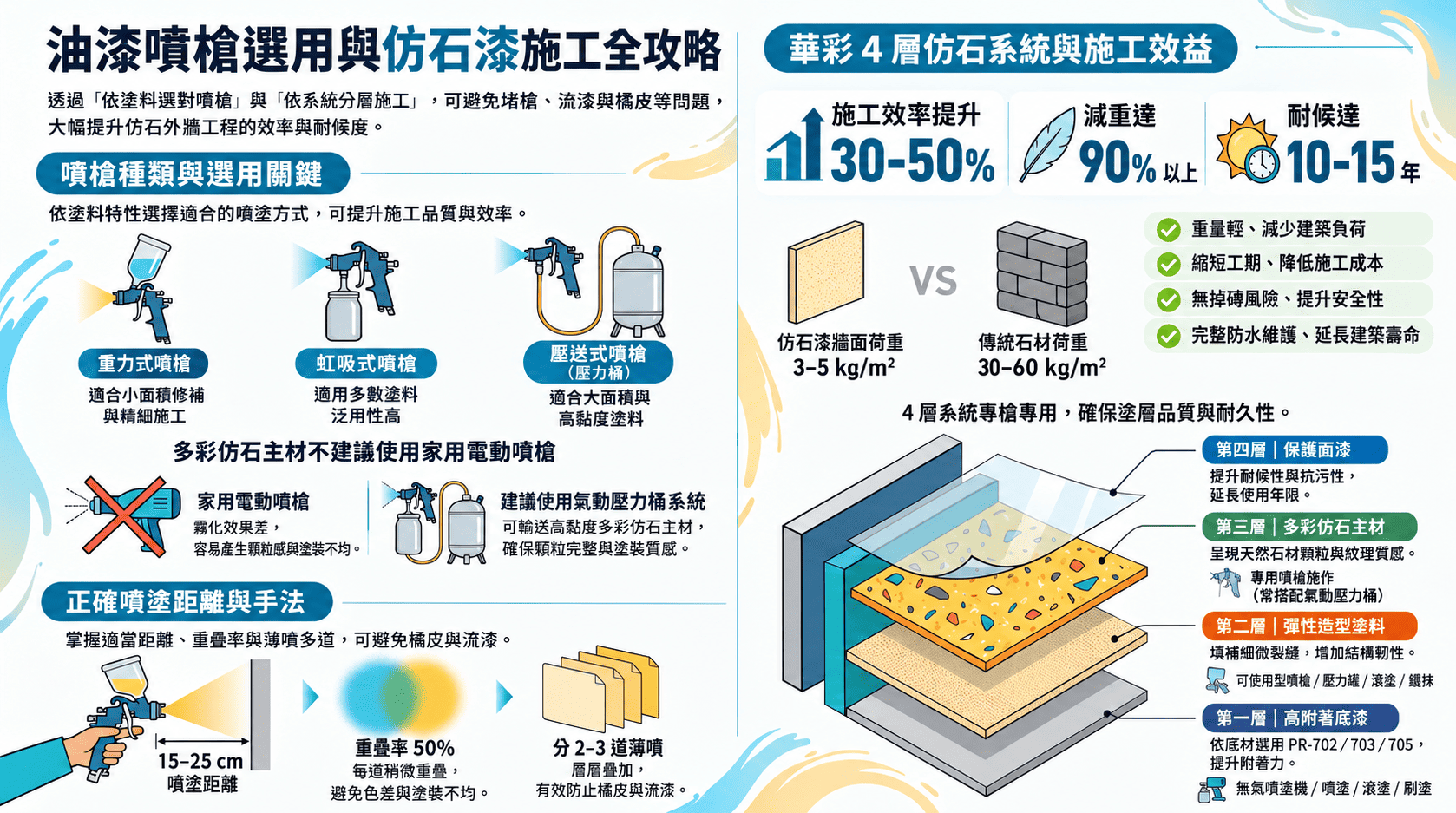
- Hua Tsai's 4-layer faux stone system: primer can be sprayed, rolled or applied with an airless sprayer; modeling paint uses a C-type spray gun or pressure pot; the faux stone topcoat is sprayed, typically with a pneumatic pressure pot.
- PR-702 primer is diluted with water at 1:3–4 and covers 330–360 m² per 5 gallons (1 coat); elastic modeling paint is diluted with about 10% water.
- Keeping a spray distance of about 15–25 cm, overlapping each pass by about 50% and applying 2–3 thin coats greatly reduces runs and orange peel.
- Spray-applied faux stone can raise installation efficiency by 30–50% and cut wall load from 30–60 kg/m² (natural stone) to 3–5 kg/m².
In Taiwan's humid, rainy climate with high levels of airborne dust, half the quality of an exterior paint job is decided before the trigger is ever pulled. The same quality coating can produce a fine, even stone texture with the right spray gun, or clogging, spitting and patchy granule patterns with the wrong one.
As architectural coating specialists, Hua Tsai (Medusa Paint) wants you to know this: no spray gun is simply good or bad. What matters is whether it suits the coating and the job site. This article is a full update of our earlier piece, "Spray Gun Types and Uses." It adds more spray gun types, explains the features, pros and cons, and typical applications of each, and draws on official application data from Hua Tsai's faux stone coating system to help homeowners, designers and contractors choose the right tool the first time.
1. What Is a Spray Gun? How to Choose One: Start with Coating, Area and Air Supply
A spray gun uses compressed air or pressurized liquid to atomize coating and apply it to a surface. It is widely used in architectural painting, furniture and woodwork, metal parts and automotive refinishing. Compared with brushes and rollers, a spray gun gives a more even film, works faster and can create textures that brushing and rolling cannot, such as the multi-color granules of faux stone coatings.
There are many types of spray guns, however, and choosing the wrong one means rework. Before buying, answer three questions: what coating will you spray, how large is the area, and is there a stable air supply on site?
Condition 1: Coating Viscosity Determines the Gun Type
Clear coats and topcoats are low-viscosity and atomize finely through a small nozzle. Primers and modeling paints are thicker and need a larger nozzle or pressure feed. A faux stone topcoat containing colored granules needs a spray system that delivers the granules steadily without breaking up the pattern.
Conditions 2 and 3: Area and Air Supply Determine the Equipment Level
Cabinet doors, tabletops and metalwork are small jobs, and a gravity-feed gun or household electric sprayer is enough. Full exterior walls, townhouses and building facade renovations need large capacity and continuous output, and are usually handled by professional crews using pressure pots or airless sprayers. Pneumatic guns must be paired with an air compressor that delivers enough airflow, so evaluate both before you buy.
| Factor | Common Mistakes / Problems | Correct Approach / Hua Tsai Solution | Quantified Indicators |
|---|---|---|---|
| Coating viscosity | Forcing faux stone topcoat through a thin-paint gun, causing clogging and spitting | Match the tool to each layer: primer can be rolled or sprayed; topcoat uses a pressure-feed system | Hua Tsai faux stone system has 4 layers, each with different tool needs |
| Application area | Using a household electric sprayer on a full exterior wall: slow progress, uneven spray width | Leave large exterior areas to professional crews with pressure pots or airless equipment | Spray-applied method raises efficiency by 30–50% |
| Air supply | Small household compressor loses pressure after a few minutes of continuous spraying | Choose a compressor whose airflow matches the gun's rated air consumption | Compressor airflow must exceed the gun's requirement |
| Frequency of use | Buying a full equipment set to spray one or two pieces of furniture | For occasional jobs, use a roller/brush or hire a professional crew | Full pneumatic set approx. NT$5,000–30,000 (market reference) |
Chapter Summary: The first step in choosing a spray gun is not comparing prices, but confirming the coating, area and air supply. Coating viscosity determines the gun type, area determines the equipment level, and air supply determines whether you can spray continuously. Once these three line up, move on to the next chapter to choose a specific gun type.
2. What Types of Spray Guns Are There? Gravity, Siphon and Pressure Feed Compared
Conventional pneumatic spray guns fall into three types based on how coating reaches the nozzle: gravity-feed, siphon-feed and pressure-feed. Each feed method suits different coating viscosities, capacities and job sizes.
Many people mix up terms like "top cup," "bottom cup," "suction" and "siphon." The simplest way to tell them apart is to look at where the paint cup sits: above the gun, below it, or in a separate pressure pot on the ground.
Gravity-Feed Spray Gun (Top Cup): The Choice for Small, Detailed Work
The paint cup sits on top of the gun, and coating flows into the nozzle by gravity. It uses little paint, leaves little residue and is highly maneuverable, and can spray higher-viscosity coatings measuring about 20–30 seconds in a viscosity cup. The downside is a small cup that needs frequent refilling, making it unsuitable for whole walls or full-body painting. Typical applications: cabinet doors, furniture, metalwork, spot repairs and small topcoat areas.
Siphon-Feed Spray Gun (Bottom Cup): Larger Capacity for Medium Areas
The paint cup sits below the gun. Airflow passing through the nozzle creates negative pressure that draws coating up from the cup. It offers large capacity and good atomization for larger areas; the downsides are a heavier cup that tires the hand over long sessions, and paint that tends to remain at the bottom of the cup. Typical applications: medium-sized walls, door and window frames, and metal components.
Pressure-Feed Spray Gun (Pressure Pot): The Workhorse for Large Areas and High Viscosity
Coating is held in a separate pressurized tank and delivered to the gun through a fluid hose, so the gun itself is light. It offers large capacity, steady output and good atomization, and handles thicker coatings and large surfaces; the downsides are tedious color changes and time-consuming hose cleaning. Typical applications: exterior walls, large areas of modeling paint and faux stone topcoat. It is also the pneumatic pressure pot system commonly used for Hua Tsai faux stone finishes.
| Factor | Common Mistakes / Problems | Correct Approach / Hua Tsai Solution | Quantified Indicators |
|---|---|---|---|
| Gravity-feed (top cup) | Used for a full exterior wall: constant refilling, visible lap marks | Cabinets, doors, furniture, spot repairs and small topcoat areas | Sprays higher-viscosity coatings of about 20–30 sec (viscosity cup) |
| Siphon-feed (bottom cup) | Hand fatigue over long sessions; paint wasted at the cup bottom | Medium-sized walls, door and window frames, metal components | Larger capacity than gravity-feed, good atomization |
| Pressure-feed (pressure pot) | Used on small jobs with frequent color changes; high cleaning cost | Large areas of high-viscosity coatings: exterior walls, modeling paint, faux stone topcoat | Continuous, steady output; a full wall can be finished in one pass |
| Naming confusion | Mixing up top/bottom cup and suction terms leads to buying the wrong gun | Identify the type by cup position and feed method | Cup on top = gravity; cup below = siphon; separate tank = pressure feed |
Chapter Summary: Gravity-feed is precise, siphon-feed holds more, and pressure-feed delivers steady, continuous output. None of the three is better overall; the key is the job size and coating viscosity. For large, high-viscosity jobs such as faux stone facades, a pressure-feed pot system is usually the most reliable choice.
3. HVLP, Electric, Airless or Hopper Gun? Features and Applications of Four Modern Spray Guns
Beyond the three conventional pneumatic guns, four other types have become common in architectural and home painting: HVLP guns, household electric sprayers, airless sprayers and hopper guns designed for thick, textured coatings.
What sets these four apart is not cup position but how they atomize coating, so the coatings and job sizes they suit vary even more widely.
HVLP Spray Gun: Fine Atomization, Less Overspray
HVLP (High Volume Low Pressure) guns atomize coating with high air volume at low pressure. The industry generally defines them as having atomizing pressure at the air cap of no more than about 10 psi. They produce less overspray and higher transfer efficiency, and suit furniture, woodwork, interior doors and fine topcoats. The downside is high air consumption, requiring a compressor with ample airflow.
Household Electric Sprayer: Entry-Level DIY, but Limited with Multi-Color Granules
With a built-in pump or turbine, it plugs straight into the wall and needs no compressor. It sprays evenly and quickly, is affordable, and is easy to move around outdoors. The downsides are higher noise and higher paint consumption. According to Hua Tsai's official information, electric sprayers give limited results with multi-color granule coatings and are better suited to primers, single-color topcoats and small renovation jobs.
Airless Sprayer: The Most Efficient Option for Large Areas
A high-pressure pump forces coating directly out of the nozzle to atomize it, without compressed air. Typical working pressure is about 1,500–3,000 psi (depending on the model). It delivers the highest output and efficiency, suiting full exterior wall primers, latex paint and large areas of protective topcoat. The downsides are expensive equipment, wide overspray, extensive masking and the need for trained operators. Hua Tsai's PR-702 primer is officially rated for airless sprayer application.
Hopper Gun: Built for Thick Modeling and Textured Coatings
A large open hopper sits on top; coating drops in by gravity and is then sprayed out by compressed air. Its large orifice can handle high-viscosity coatings and coatings containing aggregate, and it is commonly used for modeling paint, sand textures and thick intermediate coats. Hua Tsai officially specifies a C-type spray gun or pressure pot for its elastic modeling paint; confirm that your equipment model meets the product specification before starting.
| Factor | Common Mistakes / Problems | Correct Approach / Hua Tsai Solution | Quantified Indicators |
|---|---|---|---|
| HVLP spray gun | Paired with a small compressor; insufficient airflow causes poor atomization | Furniture, woodwork, interior doors, fine topcoats | Air cap atomizing pressure generally no more than about 10 psi |
| Household electric sprayer | Expecting a professional multi-color faux stone texture | Primers, single-color topcoats, small DIY renovations | Market reference price approx. NT$1,000–5,000 |
| Airless sprayer | Heavy overspray without proper masking, soiling windows, doors and floors | Exterior primers, latex paint, large areas of protective topcoat | PR-702 can be applied by airless sprayer; 330–360 m² per 5 gallons |
| Hopper gun | Spraying thick coatings through a small-nozzle gun; aggregate clogs the nozzle | Modeling paint, sand textures, thick intermediate coats | Hua Tsai elastic modeling paint: C-type spray gun or pressure pot |
Chapter Summary: HVLP is about precision, electric sprayers about convenience, airless sprayers about efficiency, and hopper guns about thick coatings. These four modern guns fill gaps left by conventional pneumatic guns, but each has limits. In particular, electric sprayers are not suited to multi-color granule topcoats, so faux stone facades still rely mainly on pneumatic pressure pot systems.
4. Which Spray Gun for Faux Stone and Multi-Color Coatings? Matching Each Layer of Hua Tsai's 4-Layer System
The biggest difference between a faux stone finish and ordinary paint is that it is a multi-layer system. Each layer has a different function, viscosity and dilution ratio, so each naturally calls for a different spray tool.
Based on product information published on Hua Tsai's official website, the table below maps the 4 layers of the multi-color faux stone system to suitable spray equipment.
Layers 1 and 2: Primer and Elastic Modeling Paint
For the first layer, the high-adhesion primer is selected by substrate: PR-702 (general), PR-703 (tile) or PR-705 (metal). PR-702 can be sprayed, brushed, rolled or applied with an airless sprayer, diluted with water at 1:3–4. The second layer, elastic modeling paint, serves as the intermediate coat and base color and conceals hairline cracks. It is sprayed with a C-type spray gun or pressure pot, or can be brushed, rolled or troweled; dilute with about 10% water. Actual coverage is about 15–20 m² per 5 gallons (2 coats).
Layers 3 and 4: Multi-Color Faux Stone Topcoat and Waterproof Protective Coat
The third layer, the multi-color faux stone topcoat, creates the stone texture. It is spray-applied, typically with a pneumatic pressure pot; because it contains colored granules, electric sprayers give limited results and are not recommended for this layer. The fourth layer, the waterproof protective coat, provides UV and stain resistance and can be brushed, rolled or sprayed depending on the area. Hua Tsai's official drying time for PR-702 and elastic modeling paint is about half an hour outdoors and about 1 hour indoors; adjust for actual weather conditions.
| Factor | Common Mistakes / Problems | Correct Approach / Hua Tsai Solution | Quantified Indicators |
|---|---|---|---|
| High-adhesion primer | Skipping primer and spraying topcoat directly; poor adhesion leads to peeling | Select PR-702/703/705 by substrate; spray, brush, roll or airless sprayer | PR-702 diluted 1:3–4 with water; 330–360 m² per 5 gallons |
| Elastic modeling paint | Over-dilution weakens its ability to conceal hairline cracks | C-type spray gun or pressure pot; can also be brushed, rolled or troweled | About 10% water; actual 15–20 m² per 5 gallons (2 coats) |
| Multi-color faux stone topcoat | Sprayed with an electric sprayer: uneven granule distribution, distorted pattern | Spray-applied, typically with a pneumatic pressure pot system | Electric sprayers give limited results with multi-color granules (official information) |
| Waterproof protective coat | Skipping the protective coat leaves the texture exposed to UV and dirt | Brush, roll or spray depending on area; fully cover the topcoat | Faux stone finish weather resistance approx. 10–15+ years |
Chapter Summary: Every layer of the faux stone system has its own best tool: primer calls for efficiency, the modeling layer for thick application, the topcoat for even granule distribution, and the protective coat for full coverage. Choosing the gun layer by layer, in order, and letting each coat dry before the next keeps the stone texture both realistic and durable.
5. Matching Nozzle Size, Air Compressor and Technique: Avoid Orange Peel and Runs
Once you have the right gun type, three details determine the finished result: nozzle size, air supply setup and spraying technique. A mistake in any one of them will show on the wall.
The ranges below are common in the industry; always follow the spray gun manual and the coating's technical data sheet for actual values.
Nozzle Size and Dilution: The Thicker the Coating, the Larger the Nozzle
Common industry ranges: about 1.2–1.4 mm for thin topcoats and clear coats; about 1.5–2.0 mm for primers and thicker coatings; for even thicker coatings, switch to a large-orifice hopper gun, pressure pot or airless equipment. Water-based coatings should be thinned only with clean water or the specified thinner. Before spraying for real, test on scrap board to confirm even atomization with no coarse particles.
Compressor and Technique: Enough Airflow, Steady Distance, Multiple Thin Coats
Compressor airflow should exceed the gun's air consumption with some margin to spare. Fit an oil-water separator and a pressure regulator to prevent fish eyes, blistering and fluctuating pressure. When spraying, keep the nozzle about 15–25 cm from the wall, hold the gun perpendicular and move it parallel to the surface, pull the trigger before moving, overlap each pass by about half, and apply 2–3 thin coats. Spray corners and edges first, and stop work in rain, strong wind or high humidity.
| Factor | Common Mistakes / Problems | Correct Approach / Hua Tsai Solution | Quantified Indicators |
|---|---|---|---|
| Nozzle size | Large nozzle with thin paint causes runs; small nozzle with thick coating clogs | Choose nozzle size by coating viscosity; test spray before the wall | Topcoat 1.2–1.4 mm; primer 1.5–2.0 mm (industry common) |
| Air compressor | Small household compressor loses pressure during continuous spraying | Airflow above the gun's air consumption; fit an oil-water separator | Reduces rework from water/oil contamination such as fish eyes and blistering |
| Spray distance | Too close causes runs; too far lets the mist dry into a rough surface | Keep a steady distance from the wall with the gun perpendicular | Approx. 15–25 cm |
| Overlap and number of coats | Spraying too thick in one go causes sagging and streaks | Overlap each pass by half; apply thin coats | Approx. 50% overlap, 2–3 coats |
Chapter Summary: Match nozzle size to viscosity, air supply to air consumption, and technique to distance and overlap. These three details are the shared fundamentals of every spray gun type. Dilute to specification and test spray before the wall to minimize orange peel, runs and coarse particles.
Frequently Asked Questions (FAQ)
- Q1. What types of spray guns are there, and which is the most common?
- By feed method, there are gravity-feed, siphon-feed and pressure-feed guns; by atomization, there are also HVLP guns, electric sprayers, airless sprayers and hopper guns. Gravity-feed guns are common for detailed home work, while pressure pots and airless sprayers are common for large exterior walls.
- Q2. What is the difference between gravity-feed and siphon-feed spray guns?
- A gravity-feed gun has its cup on top, uses little paint and is highly maneuverable, suiting small areas. A siphon-feed gun has its cup below, holds more and atomizes well, but is heavier and tends to leave paint at the cup bottom. The easy way to tell: check whether the cup is above or below the gun.
- Q3. How long does a sprayed faux stone finish last?
- According to Hua Tsai's published information, faux stone finishes offer weather resistance of about 10–15+ years. Actual lifespan depends on substrate condition, workmanship, sun exposure and maintenance frequency. Applying the full 4-layer system is a prerequisite for long-term durability.
- Q4. Can faux stone coating be sprayed directly onto an old exterior wall with cracks and old paint?
- Spraying directly is not recommended. First remove loose old paint and repair cracks and leaks, then choose PR-702/703/705 high-adhesion primer according to the substrate, and use elastic modeling paint to conceal hairline cracks before spraying the faux stone topcoat.
- Q5. What should I do if the spray gun suddenly spits or stops spraying mid-job?
- Stop and check three things: whether the nozzle is clogged with dried paint or granules, whether the compressor has lost pressure, and whether the cup's air vent is blocked. After cleaning, test spray on scrap board to confirm normal atomization before returning to the wall, to avoid lap marks.
- Q6. Can an electric sprayer be used for faux stone coating?
- Electric sprayers suit primers, single-color topcoats and small renovations. According to Hua Tsai's official information, they give limited results with multi-color granule coatings; a pneumatic pressure pot system is recommended for the faux stone topcoat to ensure even granule distribution.
- Q7. What budget do I need for spray equipment?
- Based on market reference prices, household electric sprayers cost about NT$1,000–5,000, a pneumatic gun with compressor about NT$5,000–30,000, and airless sprayers usually over NT$20,000, depending on brand and specifications. For exterior wall projects, it is best to compare the total quote for hiring a contractor.
- Q8. Can homeowners spray faux stone coating on exterior walls themselves?
- Small interior feature walls or furniture can be attempted, but exterior faux stone work involves working at height, extensive masking, a 4-layer system and weather judgment, with high quality and safety risks. Professional application is recommended. Contact Hua Tsai for a preliminary exterior wall assessment.
7. Choose Hua Tsai for Lasting Value in Every Building
Low Carbon, Beautiful and Weather-Resistant: A Triple Win
Hua Tsai's multi-color faux stone coating recreates the texture of natural stone through spray application. Its wall load is only about 3–5 kg/m², compared with 30–60 kg/m² for natural stone, a weight reduction of over 90%, and it offers weather resistance of 10–15+ years. The product has completed ISO 14067 carbon footprint verification: every 1 kg of recycled material used reduces emissions by 1.27 kg CO₂e. It has also received the 2025 Taiwan Excellence Award.
Integrated Professional Systems That Solve Job-Site Pain Points
From high-adhesion primer and elastic modeling paint to multi-color faux stone topcoat and waterproof protective coat, Hua Tsai provides a complete 4-layer coating system, with the suitable spray equipment, dilution ratio and coverage clearly specified for each layer. This helps crews choose the right gun type and get it right the first time, reducing clogging, color variation and rework. The entire range is water-based, making cleanup and on-site safety management easier.
Raising Asset Value with Sustainable Aesthetics
Spray-applied faux stone can raise installation efficiency by 30–50%, helping new builds and renovation projects shorten schedules. Replacing stone with coating also eliminates the safety risk of falling tiles and stone. For developers, designers and owners of older buildings, it is a facade solution that balances appearance, structural load and ESG credentials.
| Factor | Common Mistakes / Problems | Correct Approach / Hua Tsai Solution | Quantified Indicators |
|---|---|---|---|
| Wall load | Natural stone cladding: heavy structural load and risk of detachment | Spray-applied multi-color faux stone coating instead of stone | 3–5 kg/m² vs. stone at 30–60 kg/m² |
| Installation efficiency | Dry-hung or wet-laid stone takes a long time to install | Spray-applied 4-layer faux stone system | Efficiency raised by 30–50% |
| Weather resistance | Ordinary exterior paint fades and chalks easily | Faux stone topcoat + waterproof protective coat | Weather resistance of 10–15+ years |
| Low carbon and sustainability | Material carbon emissions are not transparent | ISO 14067 carbon footprint verification; recycled materials used | Every 1 kg of recycled material cuts 1.27 kg CO₂e |
Chapter Summary: Choosing the right spray gun type is the starting point for spray quality; choosing the right coating system is what guarantees long-term value. With a complete 4-layer faux stone system, clear application specifications and low-carbon certification, Hua Tsai helps buildings achieve beauty, weather resistance, lighter weight and sustainability together. Want to know which spray method suits your exterior wall? Contact us for a free preliminary facade assessment.
Contact Information
☎
Phone ▏ +886-7-365-6297
Address ▏ No. 4, East 3rd Street, Nanzih Export Processing Zone, Kaohsiung, Taiwan
Website ▏ https://www.medusa-paint.com.tw/
LINE ▏ https://reurl.cc/MOaYGn
